
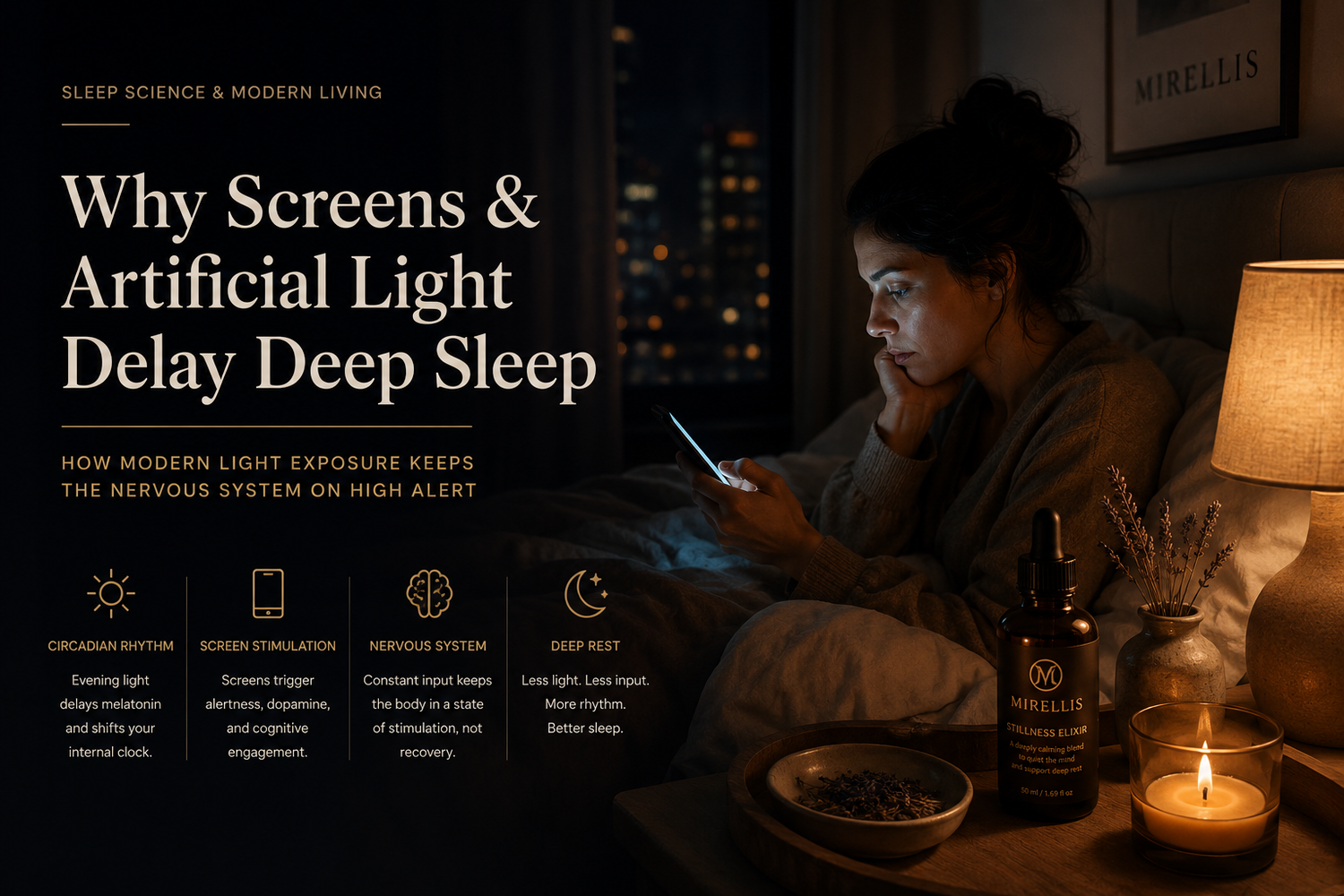
Why Screens and Artificial Light Delay Deep Sleep
Modern sleep problems are rarely caused by a lack of exhaustion.
Most people are tired.
But the nervous system is not always prepared for sleep.
The body does not enter deep rest simply because the day has ended.
It enters rest when the environment consistently signals that stimulation is decreasing.
Artificial light, screen exposure, constant notifications, and prolonged cognitive activity interfere with those signals. The result is a nervous system that remains physiologically alert long after the body wants to recover.
This is why many people feel exhausted yet unable to fully switch off.
Sleep Is Not an On/Off Switch
The nervous system transitions into sleep gradually.
Deep sleep requires:
- melatonin release
- reduction in core body temperature
- parasympathetic nervous system activation
- decreasing sensory stimulation
- reduced cognitive alertness
In natural environments, darkness helped initiate this process automatically.
Modern environments interrupt it continuously.
Bright screens, overhead lighting, rapid visual stimulation, and emotional engagement keep the brain in a state of alertness that conflicts with the body’s preparation for sleep.
The nervous system does not interpret screens as “relaxation.”
It interprets them as stimulation.
How Artificial Light Affects Circadian Rhythm
The human circadian rhythm is heavily influenced by light exposure.
Specialized cells in the retina communicate directly with the brain’s suprachiasmatic nucleus — the internal clock responsible for regulating sleep timing, hormonal rhythms, temperature, and alertness.
Exposure to artificial light during the evening delays melatonin production and shifts the nervous system toward wakefulness.
This becomes more significant when:
- screens are viewed at close distance
- exposure continues late into the night
- lighting remains bright indoors after sunset
- stimulation is emotionally or cognitively engaging
The issue is not only “blue light.”
It is prolonged sensory activation.
The brain uses environmental signals to determine whether the body should remain alert or begin shutting down.
The Brain Does Not Distinguish Between Work and Scrolling
Many people assume they are resting while using their phones at night.
Physiologically, the brain often experiences the opposite.
Scrolling continuously introduces:
- novelty
- emotional shifts
- rapid attention switching
- dopamine stimulation
- cognitive unpredictability
The nervous system remains engaged because it is still processing input.
This is why someone can spend an hour in bed scrolling and still feel mentally active afterward.
The body may be physically still.
But the nervous system is not at rest.
Why the Nervous System Responds to Atmosphere
Sleep preparation is influenced by environmental conditioning.
Over time, the brain learns to associate certain sensory environments with specific physiological states.
Warm lighting, reduced sound, slower pacing, stillness, familiar rituals, and repeated sensory patterns gradually become signals of safety and decompression.
Research in behavioral neuroscience shows that repeated environmental cues can condition the nervous system into anticipating specific physiological outcomes.
This relationship between atmosphere, sensory conditioning, and physiological state is explored further in our article on The Science of Ritual: How Environment Shapes the Nervous System.
This is one reason evening rituals become powerful over time.
The ritual itself is not magical.
The nervous system learns the pattern.
Deep Rest Requires Decreasing Stimulation
The body cannot move efficiently toward deep sleep while sensory input continues to intensify.
Modern environments often maintain:
- constant brightness
- constant audio
- continuous information exposure
- emotional unpredictability
- uninterrupted digital engagement
The nervous system rarely experiences a true transition into stillness.
Instead, most people move directly from work into more stimulation.
This continuous exposure to stimulation is one reason modern environments make it difficult for the brain to fully disengage at night, a concept discussed in Why Modern Life Keeps the Brain in Stimulation Mode.
This creates a form of physiological carryover where the stress response remains partially active into the night.
The consequence is often:
- delayed sleep onset
- shallow sleep
- fragmented sleep
- mental fatigue
- poor emotional recovery
Why Evening Rituals Matter
An evening ritual is not about productivity.
It is about creating conditions that support nervous system deceleration.
Simple environmental shifts can meaningfully influence how the body prepares for sleep:
- dimmer lighting
- reduced screen exposure
- slower movement
- quieter environments
- warm sensory cues
- repetitive calming behaviors
Consistency matters more than intensity.
The nervous system responds strongly to repeated patterns.
When a calming sensory sequence is repeated consistently, the body gradually begins associating that sequence with safety, recovery, and sleep readiness.
The Goal Is Not Sedation. It Is Transition.
Deep sleep cannot be forced.
The nervous system must gradually feel permitted to disengage from alertness.
This is why atmosphere matters.
The body responds not only to chemicals or supplements, but to:
- light
- sound
- temperature
- repetition
- sensory rhythm
- environmental predictability
Sleep begins long before the eyes close.
It begins with the signals the nervous system receives throughout the evening.


