The Science of Ritual: How Environment Shapes the Nervous System
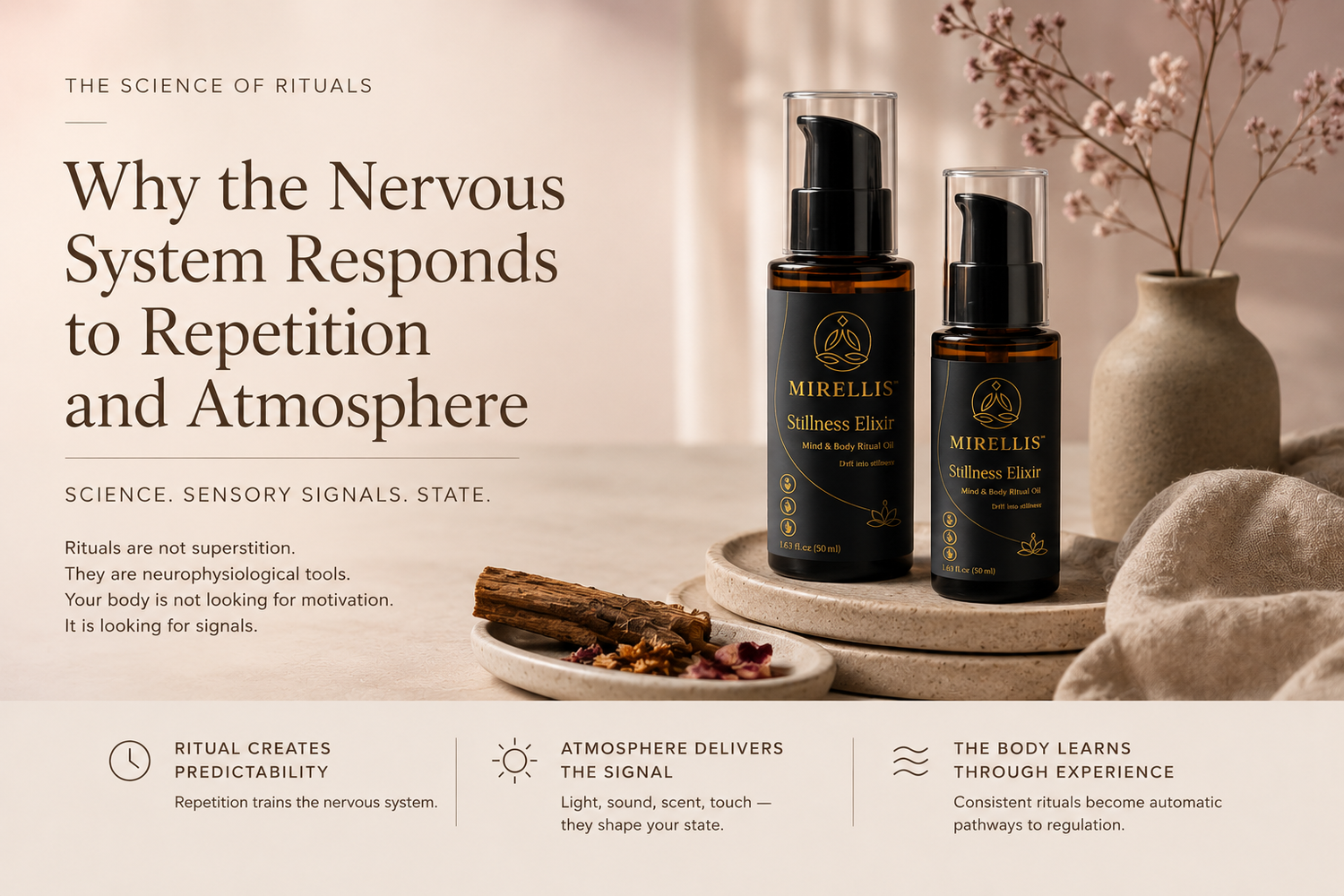
Why the Nervous System Responds to Repetition and Atmosphere
The Modern Nervous System Is Overstimulated
There is a particular kind of exhaustion that sleep alone does not fix. It accumulates across days — not from physical exertion, but from something subtler. The relentless, low-grade demand of an environment that never settles. That never signals: this part of the day is over.
The contemporary nervous system is asked to process more unpredictability per hour than at any point in human history. Notifications arrive without pattern. Light levels shift with no reference to the sun. Meals, movement, and rest happen not when the body signals readiness, but when a gap in the calendar permits.
The transitions between work and rest — between public and private, stimulation and stillness — have largely collapsed.
The autonomic nervous system operates most efficiently within environments it can predict. When the environment becomes persistently fragmented, the system does not simply adapt. It remains, in a low-grade way, alert. Waiting. Spending resources it cannot recover overnight.
This is where rituals enter the conversation — not as spirituality, and not as self-help, but as something the neuroscience literature has been documenting quietly for decades. Biological regulation systems. Structured, repeated, sensory-grounded behaviors that speak directly to the nervous system in the language it understands best.
The language of pattern.
What Is a Ritual, Scientifically?
Not a habit. A conditioned response.
The word "ritual" carries cultural weight that can obscure its functional meaning. In behavioral neuroscience, a ritual is not a ceremony — and it is not synonymous with habit, though the distinction between the two is precisely where the science becomes interesting.
Habits
Exist to reduce cognitive load. They become automated through repetition. When you lock the door without thinking, or navigate a familiar route on autopilot, habit is doing its work: freeing attentional resources for novel demands.
Rituals
Generate psychological safety and cognitive anchoring. The distinction lies in intentionality, sensory structure, and the presence of transition-marking — the deliberate demarcation of one mental or physiological state from another.
Ritualized behaviors, even simple and secular ones, engage specific processes around meaning-making and emotional regulation that habitual behaviors do not. Rituals communicate something to the self. They signal: This moment is different from the one before it.
Reduced Cortisol Reactivity
Measurable decreases in stress hormone response following ritualized behavior sequences.
Greater Heart Rate Variability
A key marker of autonomic nervous system flexibility and resilience.
Improved Emotional Regulation
Documented across behavioral psychology, sports science, and clinical research.
Rituals are not superstition encoded in behavior. They are a form of physiological communication.
Why the Brain Responds to Repetition
The nervous system anticipates before it reacts.
To understand why the nervous system responds to ritual, it helps to understand how the brain processes the future. The dominant framework in contemporary cognitive neuroscience — predictive processing — holds that the brain is not primarily reactive. At every moment, it is generating models of what is about to happen, comparing incoming sensory data against those models, and updating accordingly.
The currency of this system is prediction error: the gap between what was expected and what arrived. Prediction error is metabolically expensive. It triggers arousal, recruits attentional resources, and activates the hypothalamic-pituitary-adrenal (HPA) axis — the system responsible for cortisol production. In small, meaningful doses, this is adaptive. Sustained across hours and days, in an environment of persistent unpredictability, it contributes to the fatigue, irritability, and nervous system dysregulation that are now broadly normative.
Repetition reduces prediction error. When a sequence of behaviors is performed consistently — same order, same sensory inputs, same time of day — the brain's predictive models become accurate. There is less updating required. The nervous system, in a functional sense, relaxes.
Sympathetic Activation
The arousal branch: cortisol, elevated heart rate, vigilance. Triggered by unpredictable environments and persistent prediction error.
Parasympathetic Dominance
The restoration branch: digestion, immune activity, sleep. Supported by predictable environments and consistent sensory sequences.
A structured daily routine doesn't just feel better. It produces measurably lower cortisol levels across the day — not because the routine is intrinsically relaxing, but because it reduces the nervous system's need to remain in a state of anticipatory readiness. The nervous system learns the sequence. It stops bracing.
The Nervous System Responds to Atmosphere First
Before you do anything, your environment has already spoken.
Before any deliberate action is taken, the nervous system has already begun reading the room. The limbic system — the brain's primary architecture for emotional processing and threat assessment — processes environmental inputs before they reach conscious awareness.
Light
A biological signal that carries information about time of day and appropriate physiological state.
Temperature
Core body temperature shifts are part of the circadian preparation for sleep — the environment can support or resist this process.
Sound
Frequency and regularity of sound directly modulate sympathetic and parasympathetic tone.
Scent
Olfactory input bypasses cortical processing, traveling directly to emotional memory centers.
The nervous system responds to atmosphere not as decoration. As data.
Light
The brain's master circadian pacemaker receives direct input from cells in the eye that are maximally sensitive to short-wavelength, blue-spectrum light. Bright blue light in the evening suppresses melatonin production and delays the body's internal clock — a finding consistently documented in chronobiology research.
Warm, low-intensity light is read by the circadian system as a signal of day's end.
This relationship between artificial light exposure, circadian rhythm, and nervous system activation is explored further in our article Why Screens and Artificial Light Delay Deep Sleep.
It doesn't just feel softer. It initiates the neurochemical preparation for sleep.
Blue-spectrum light in the evening suppresses melatonin and delays the body's internal clock.

Scent
Olfactory input travels directly to the amygdala and hippocampus — the brain's centers for emotional memory and threat processing — without the cortical relay that visual and auditory information must pass through. This is why smell produces rapid, involuntary emotional responses. It bypasses deliberation.
It also means that scent functions as a remarkably efficient ritual anchor. Introduce a consistent fragrance at the beginning of an evening wind-down, and the olfactory-limbic pathway begins to associate that input with what follows. Over time, the scent alone begins to initiate the parasympathetic shift — before the rest of the ritual has even begun.
Certain compounds — lavender, specific terpenes — have demonstrated measurable effects on autonomic arousal: reductions in heart rate, decreases in galvanic skin response. The mechanism is not mystical. It is neurochemical.

Sound
Low-frequency, rhythmically regular sound is associated with parasympathetic activation. Harsh, unpredictable, or high-frequency sound maintains sympathetic tone.
The shift from a high-stimulation sonic environment to one that is quiet or rhythmically simple is not merely pleasant. It is a measurable physiological transition — one that sensory environments designed around sound and recovery can actively support.
High Stimulation Sound
Harsh, unpredictable, high-frequency — maintains sympathetic tone and arousal.
Low Stimulation Sound
Rhythmically regular, low-frequency — associated with parasympathetic activation and restoration.
The Transition
Moving between these sonic environments is a measurable physiological event, not merely a subjective preference.
What This Means for Sensory Environments
When the same light, scent, and sound consistently precede rest, the nervous system does not wait for sleep to begin decompressing. It begins earlier, following the sensory signature it has learned to associate with safety and stillness.

Atmosphere is not ambiance. It is instruction.
What an Evening Ritual Actually Feels Like
This is worth slowing down for. Not the neuroscience of it — the experience of it.
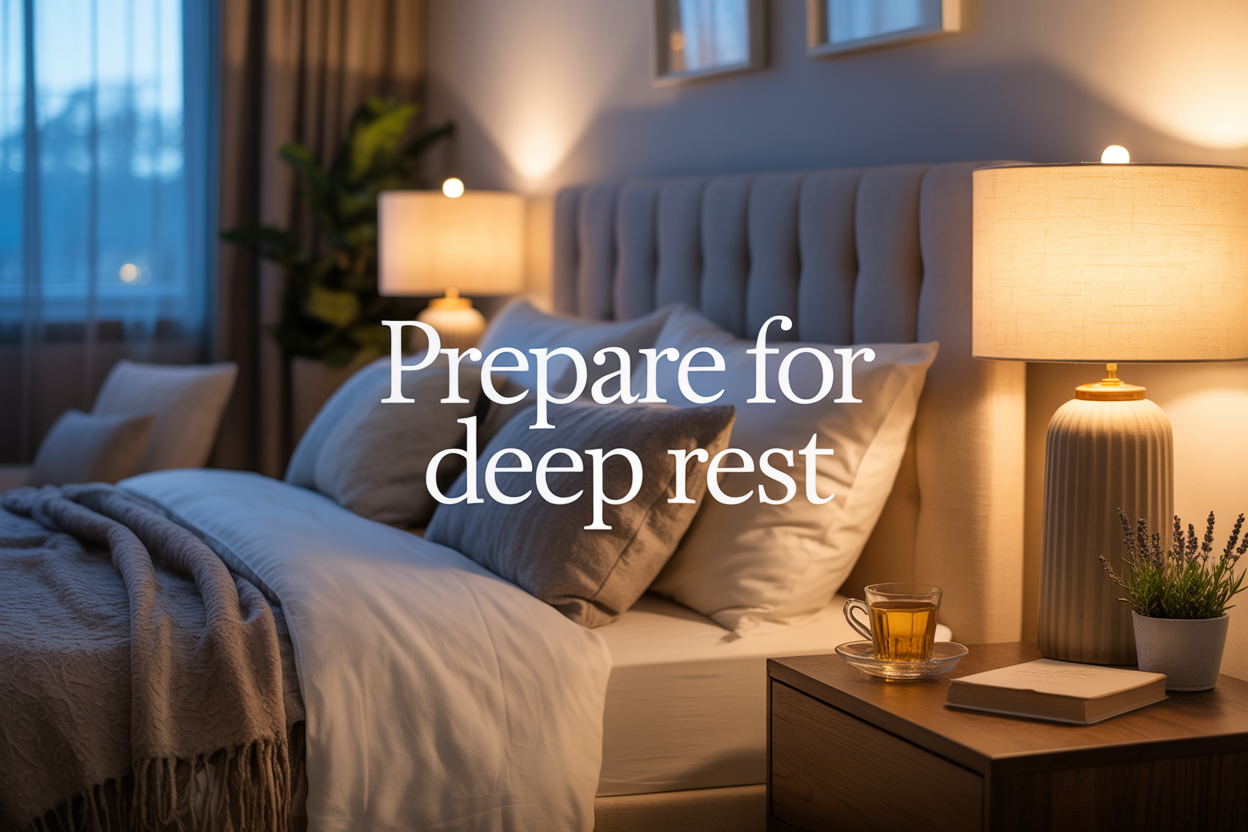
The light in the room has shifted. Warmer. Lower. The overhead lights are off, and there's something in the air — a scent you've come to associate, without thinking about it, with the end of the day. Your hands, which have been moving quickly for hours, have slowed. The sound around you is quieter now, or more regular — something without edges.
Your body is beginning to cool. That's not incidental; core body temperature drops naturally as part of the circadian preparation for sleep, and a cooling environment supports rather than resists that process. You're not doing anything dramatic. You're not trying.
That's the point. The ritual has already begun doing what it was designed to do.
The nervous system, recognizing the sequence, has started its transition toward the parasympathetic state — toward restoration, digestion, repair — without being asked directly. It read the room. It understood.
This is what sensory environments are actually for. Not aesthetics. Not mood. Nervous system communication, conducted through the senses, before the mind gets involved.
Evening Rituals and Parasympathetic Activation
THE TRANSITION MATTERS AS MUCH AS THE DESTINATION.
The hours between work and sleep are, neurologically, among the most consequential of the day — and among the most poorly structured in contemporary life. The shift from sympathetic to parasympathetic dominance is not instantaneous.
60–90
Minutes
The physiological half-life of cortisol. The nervous system does not have an off switch — it has a deceleration gradient.
2
Key Phases
Sleep onset requires both melatonin release and core body temperature reduction — both need sustained decreasing stimulation to proceed efficiently.
Circadian biology research has established that the timing of sensory inputs matters significantly. Light exposure, activity level, and even meal timing send signals to the brain's internal clock that either support or conflict with the body's preparation for sleep. An evening ritual that consistently aligns sensory experience with circadian signals — dim light, reduced sound, stillness, warmth — reinforces what the body is already trying to do.
Research in behavioral sleep medicine demonstrates that the nervous system learns to associate specific environments, behaviors, and sensory sequences with specific physiological states. When a consistent pre-sleep sequence is repeated, those behaviors become, over time, reliable triggers for the neurophysiological cascade that precedes sleep onset.
The ritual does not force the nervous system into rest. It creates the conditions under which the nervous system can find its way there, without resistance.
Why Modern Life Has Lost Ritual Structures
WE DIDN'T LOSE RITUAL. WE DISMANTLED ITS INFRASTRUCTURE.
The loss of ritual in contemporary life is often discussed as a cultural concern. Less often is it examined as a neurological one.
Historical Architecture
For most of human history, the architecture of the day was externally imposed. Sunrise and sunset structured light exposure. Work, meals, and rest followed rhythms largely consistent across the community. Transitions were marked — by mealtimes, by the close of the working day, by evening practices that differed meaningfully from what preceded them.
The structure was not always comfortable or chosen. But it was predictable. And predictability is not merely a preference — it is a physiological resource.
The Digital Disruption
Digital technology disrupted this architecture in ways we are still absorbing. The always-on environment — email at midnight, entertainment at any hour, social engagement without temporal boundary — collapsed the transitions that once served as natural nervous system regulation zones.
Light levels that should be falling are maintained by screens. Cognitive demands that should be winding down continue through notification, scroll, and reply. The brain's prediction systems, which depend on pattern to generate accuracy, are denied the regularities they evolved within.
Difficulty falling asleep
Has become so common as to be unremarkable — a direct consequence of collapsed evening transitions.
We explore this modern overstimulation cycle further in Why Modern Life Keeps the Brain in Stimulation Mode.
Baseline fatigue
Persists regardless of hours in bed, because the nervous system never fully decelerated.
Cognitive fragmentation
Resists the usual remedies — a symptom of chronic low-grade dysregulation, not acute stress.
The absence of ritual is not a minor inconvenience. It is the removal of a nervous system regulation infrastructure that was built over millennia and dismantled in a decade.
Rituals as a Form of Nervous System Design
THE ENVIRONMENT IS NOT A BACKDROP. IT IS A REGULATORY INPUT.
There is a perspective emerging across behavioral medicine and environmental psychology that treats the daily environment not as a backdrop to human experience, but as an active input to physiological function. The conditions under which a person lives — their light environment, their sound environment, their patterns of movement and rest — are not incidental. They are regulatory.
Ritual as Infrastructure
An evening ritual is not a luxury, nor a performance of wellness. It is infrastructure. Its components — consistent timing, specific sensory cues, intentional transition behaviors — create the predictable sensory environment that allows the nervous system to begin its shift toward parasympathetic dominance before active effort is required.
Ancient Practice Meets Neuroscience
The distinction between ancient practice and contemporary neuroscience turns out to be smaller than expected. The cultures that developed elaborate pre-sleep rituals and carefully maintained transitions between states of activity and rest were — whether they understood it in these terms or not — practicing nervous system regulation.
Environmental Design for Wellbeing
Research in environmental psychology has established that physical spaces exert measurable effects on stress physiology — that environments, like behaviors, can either sustain arousal or facilitate its reduction. The nervous system is responsive to pattern, to atmosphere, to the consistent repetition of sensory sequences that signal safety.
What has changed is the mechanism of understanding. What has not changed is the underlying biology.
Conclusion
The nervous system listens to patterns before it listens to logic. By the time conscious decision-making arrives at the question of rest, the nervous system has already been gathering evidence for hours. It has read the light in the room, the sounds in the air, the sequence of behaviors you moved through — and it has made its assessment.
What that evidence consists of is, in large part, what we choose to surround ourselves with. The quality of light in the evening hours. The sounds that occupy the transition between work and stillness. The consistency of the sequences we repeat, night after night, until the body learns what they mean.
Pattern
The nervous system evolved within structured, predictable environments. Repetition is not routine — it is regulation.
Atmosphere
Light, scent, and sound are not decoration. They are biological signals that instruct the nervous system before the mind is involved.
Architecture
Creating ritual structures, in the absence of the ones that existed before, is a form of care — quiet, deliberate, and deeply physiological.
Ritual is not mysticism repurposed for modern life. It is the recognition that the human nervous system evolved within structured, predictable environments — and that creating those structures, in the absence of the ones that existed before, is a form of care. Not the dramatic care of intervention. The quiet care of architecture.
The nervous system is listening. The question is only what we choose to say to it.
Published by Mirellis Journal
Informed by research across behavioral neuroscience, circadian biology, environmental psychology, and autonomic nervous system regulation.