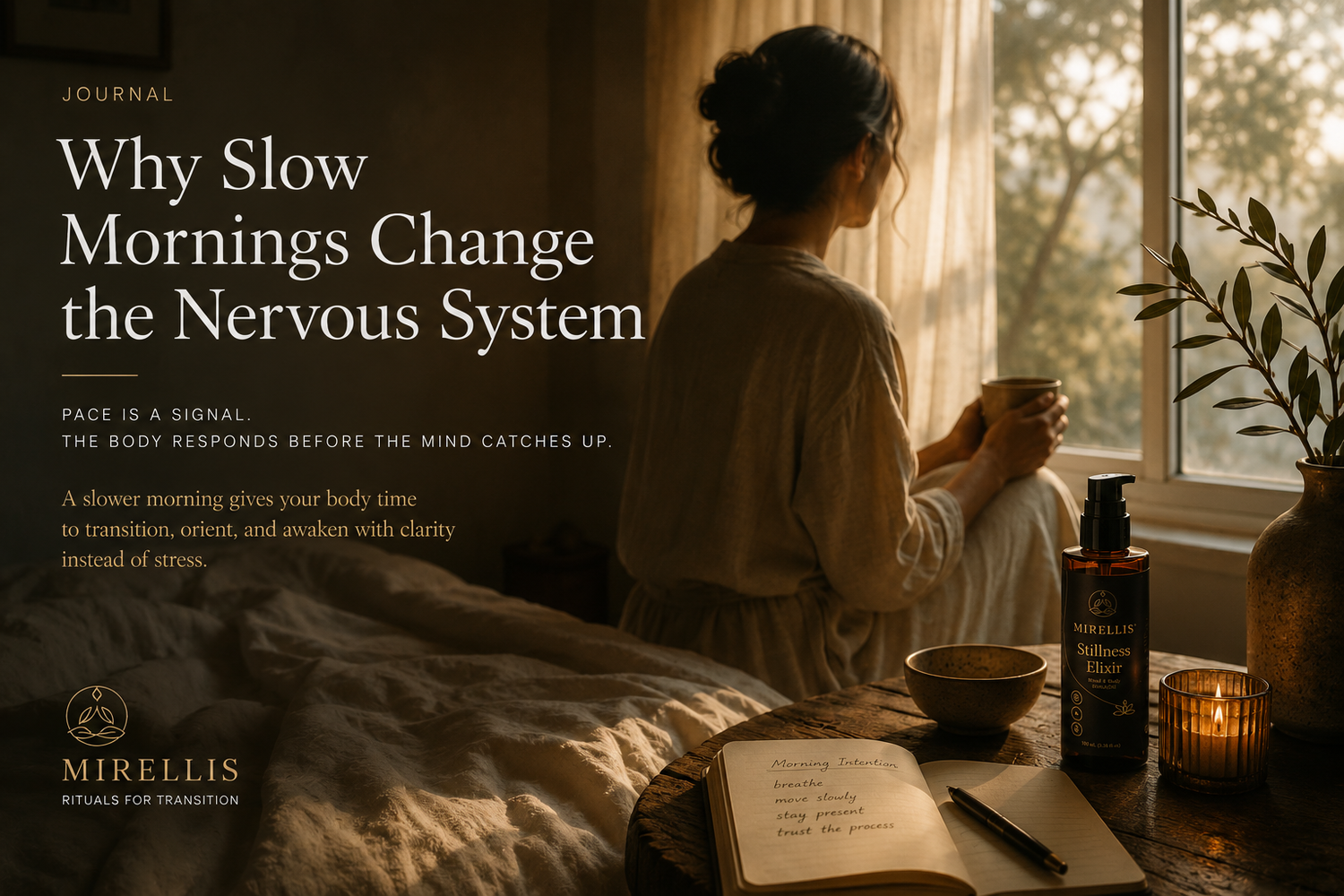
Modern mornings often begin before the body has fully arrived.
An alarm rings.
A phone lights up.
Notifications appear instantly.
The mind enters conversation before the nervous system has properly transitioned into wakefulness.
For many people, the first hour of the day now feels less like awakening and more like immediate acceleration.
The body moves quickly from sleep into stimulation:
- messages,
- headlines,
- urgency,
- schedules,
- decisions,
- bright screens,
- noise,
- mental planning.
And over time, this pace begins to feel normal.
But biologically, waking was never designed to be abrupt.
The nervous system transitions gradually.
Hormones shift slowly.
Body temperature rises progressively.
Breath changes.
Light sensitivity changes.
Attention reorients.
The brain moves through different states of activation before cognitive clarity fully stabilizes.
The body needs transition time.
And when mornings consistently begin too quickly, the nervous system often carries that acceleration into the rest of the day.
The Nervous System Wakes Gradually
Most people think waking up is a single moment.
But biologically, awakening is a process.
The body moves through a coordinated physiological transition involving:
- cortisol awakening response,
- circadian signaling,
- autonomic nervous system activation,
- hydration shifts,
- respiratory changes,
- light sensitivity,
- temperature regulation,
- attentional orientation.
This process unfolds over time.
The nervous system is slowly preparing the body for engagement with the environment.
But modern environments rarely respect this transition.
Instead, many people wake directly into:
- urgency,
- cognitive overload,
- information density,
- emotional stimulation,
- and fragmented attention.
The body receives more signals than it can coherently process within the first few minutes of consciousness.
And the nervous system often responds by entering a state of heightened activation very early in the day.
Stress Often Begins Before the Day Begins
For many people, stress no longer begins at work.
It begins beside the bed.
The nervous system may enter anticipatory activation immediately upon waking:
- unfinished thoughts,
- unread notifications,
- emotional tension,
- performance pressure,
- overstimulation,
- constant accessibility.
Even before movement begins, the body may already feel:
- behind,
- rushed,
- mentally loaded,
- emotionally accelerated.
Over time, this creates a nervous system that rarely experiences gradual orientation.
The body learns to wake defensively.
And when defensive activation becomes habitual, mornings can begin feeling mentally loud before the day has even properly started.
This does not always appear dramatic externally.
Sometimes it simply feels like:
- subtle anxiety,
- mental racing,
- emotional heaviness,
- shallow breathing,
- irritability,
- difficulty focusing,
- or a persistent inability to feel settled.
The nervous system often carries the tone of its beginning throughout the day.
The Difference Between Activation and Overstimulation
Modern culture often confuses activation with intensity.
But they are not the same thing.
Healthy activation feels:
- coherent,
- awake,
- clear,
- energized without agitation.
Overstimulation feels:
- fragmented,
- mentally noisy,
- hurried,
- reactive,
- cognitively crowded.
The body can be alert without being overwhelmed.
But many modern routines prioritize stimulation over coherence.
Bright screens,
fast scrolling,
constant information,
loud audio,
immediate caffeine,
and rapid multitasking all increase sensory load very early in the morning.
The nervous system responds accordingly.
And over time, many people stop recognizing the difference between:
- feeling awake,
and - feeling overstimulated.
The Body Responds to Pace
The nervous system is deeply responsive to pacing.
Not only to what happens,
but to how quickly it happens.
Fast transitions often increase physiological tension.
Slower transitions allow the body more time to orient.
This is one reason many people intuitively feel calmer after:
- sitting quietly near sunlight,
- drinking warm water slowly,
- stretching gently,
- listening to softer sounds,
- walking without rushing,
- breathing deeply,
- or beginning the morning without immediate digital stimulation.
These experiences create pacing coherence.
The nervous system interprets pace as information.
And a slower beginning often communicates:
- safety,
- predictability,
- spaciousness,
- and reduced environmental threat.
This does not mean mornings must become rigid rituals or perfectly controlled environments.
Even small reductions in sensory acceleration can change how the body feels moving into the day.
Slowness Is Not Laziness
Modern life often frames slowness negatively.
Slow means:
unproductive,
behind,
unmotivated,
inefficient.
But biologically, slower pacing is not always a lack of energy.
Sometimes it is regulation.
The body does not always struggle because it is tired.
Sometimes it struggles because it was accelerated too quickly.
A nervous system pushed immediately into stimulation may appear functional externally while remaining internally fragmented.
This fragmentation often accumulates quietly:
- reduced focus,
- emotional fatigue,
- nervous tension,
- irritability,
- cognitive exhaustion,
- sleep difficulty later at night.
Slower mornings are not necessarily about doing less.
They are often about reducing unnecessary friction between the body and the environment.
Why Gentle Sensory Inputs Matter
The first sensory experiences of the day strongly influence nervous system orientation.
Light.
Sound.
Temperature.
Breath.
Pace.
Texture.
Silence.
Movement.
The nervous system processes these signals before conscious thought fully organizes them.
Natural morning light tends to feel different from harsh artificial brightness.
Soft soundscapes feel different from aggressive notifications.
Warm water feels different from immediate stimulation.
Slow breathing feels different from rushed breathing.
The body notices these differences even when attention does not.
This may be one reason rituals across cultures historically emphasized:
- morning light,
- washing,
- oils,
- prayer,
- silence,
- breath,
- tea,
- repetitive movement,
- slower beginnings.
Not because ancient rituals were aesthetic performances.
But because human physiology responds to repeated sensory rhythms.
The Nervous System Learns Through Repetition
The body adapts to repeated patterns.
When mornings consistently begin with:
- stress,
- noise,
- urgency,
- and fragmentation,
the nervous system gradually expects acceleration.
But repeated calm signals also shape expectation.
Over time, the body begins recognizing:
- this light,
- this pace,
- this breath,
- this sound,
- this sequence.
And predictable sensory patterns can reduce internal friction.
This is one of the deeper functions of ritual.
Rituals are not merely habits.
They are repeated sensory signals.
The body responds to these signals before conscious intention fully arrives.
Morning Rituals as Biological Orientation
A slower morning is not about perfection.
Nor is it about creating elaborate wellness routines.
The goal is not to become optimized.
The goal is to become oriented.
To allow the body a more coherent transition between:
sleep
and
stimulation.
A few quieter minutes.
A slower breath.
Natural light.
Less immediate noise.
More gradual pacing.
These moments may appear small externally.
But nervous system states are often shaped through repetition, not intensity.
And over time, slower beginnings may create:
- clearer attention,
- reduced reactivity,
- emotional steadiness,
- improved pacing,
- and a more grounded relationship with the rest of the day.
Modern Life Rarely Allows True Transition
One of the hidden costs of modern life is the loss of transition.
People now move rapidly between:
- sleep and work,
- silence and information,
- stillness and stimulation,
- private space and social demand.
Very little space exists between states.
And without transition, the nervous system often remains continuously activated.
Morning rituals reintroduce transition into environments that have become chronically accelerated.
Not through dramatic intervention.
But through pacing.
Through rhythm.
Through repeated sensory coherence.
A Slower Beginning
The nervous system does not always need more stimulation.
Sometimes it needs more time to arrive.
A slower morning is not about escaping life.
It is about entering it more coherently.
Not every day will feel calm.
Not every morning will feel spacious.
But even small moments of reduced acceleration may change how the body experiences the rest of the day.
The body responds to pace.
And perhaps the way we begin the morning shapes more than we realize.
Research Notes+
Cortisol Awakening Response
Research in chronobiology suggests cortisol naturally rises during the first hour after waking, helping the body transition into alertness and environmental engagement.
Sensory Overload & Stress Activation
Continuous digital stimulation and multitasking may contribute to heightened cognitive load, attentional fragmentation, and nervous system stress.
Circadian Rhythm & Morning Light
Exposure to natural morning light plays an important role in circadian rhythm regulation, mood stability, and sleep-wake timing.
Breath & Autonomic Nervous System Activity
Slower diaphragmatic breathing may support parasympathetic nervous system regulation and reduce physiological stress activation.
Predictability & Nervous System Regulation
Behavioral neuroscience research suggests repeated environmental patterns and predictable sensory cues may help support emotional regulation and nervous system stability.
Related Reading
- The Science of Morning Rituals: How Your First Signals Shape the Nervous System
- Why Your First Signals of the Day Matter
- The Oral–Gut–Brain Connection
- Why Modern Life Keeps the Brain in Stimulation Mode
- Why Screens and Artificial Light Delay Deep Sleep
- Why the Nervous System Needs Predictability to Feel Safe