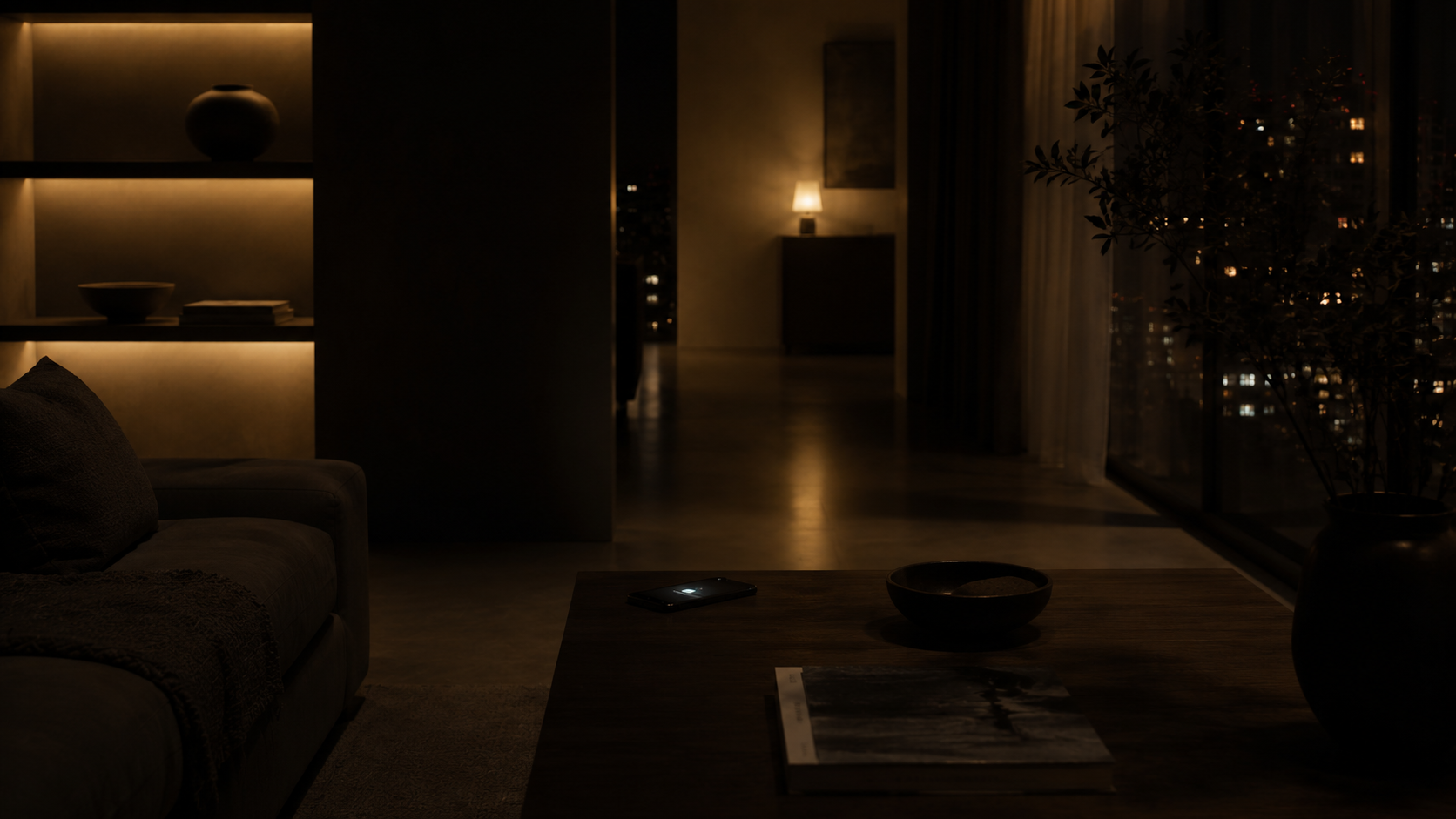
Modern humans spend much of life inside environments the nervous system was never designed to interpret continuously.
Bright indoor lighting extends late into the night. Screens remain illuminated inches from the face after sunset. Mornings often begin indoors under dim artificial light rather than natural daylight. Urban environments preserve visual intensity long after biological evening has begun.
As a result, many individuals now experience a subtle but profound form of physiological disorientation:
the body continues moving through time,
while environmental signals no longer clearly communicate it.
Human biology evolved within rhythmic light environments.
Brightness changed gradually across the day.
Morning emerged slowly.
Midday intensified naturally.
Evening softened progressively.
Darkness created recognizable closure.
Modern life increasingly flattens these transitions into continuous illumination.
And over time, the nervous system may begin losing some of the environmental timing signals that historically helped regulate:
- alertness
- pacing
- attention
- hormonal rhythm
- descent
- restoration
Light is not merely visual.
Biologically,
light is information.
The Nervous System Interprets Light as Timing Information
Most people think about light primarily through visibility.
But human physiology interprets light much more deeply.
Specialized retinal cells continuously communicate information about environmental brightness, timing, and intensity directly to brain regions involved in circadian regulation, alertness, hormonal timing, and autonomic pacing.
Among the most important structures involved is the suprachiasmatic nucleus (SCN), often described as the body’s central circadian clock.
The SCN helps coordinate daily physiological rhythms involving:
- wakefulness
- sleep timing
- body temperature
- hormone release
- metabolic activity
- attentional variation
Importantly, the nervous system does not determine time primarily through clocks.
It determines time largely through environmental signals.
And light remains the most powerful timing signal humans experience repeatedly every day.
Historically, the nervous system evolved inside environments where brightness shifted continuously and predictably.
Morning light signaled orientation.
Midday brightness supported activation.
Evening dimness communicated slowing.
Darkness supported restoration.
Modern environments increasingly weaken these transitions.
Human Biology Evolved Inside Rhythmic Light Environments
For most of human history, environmental light changed gradually across the day.
There were no permanently illuminated interiors.
No glowing screens after sunset.
No midnight exposure to high-intensity blue-enriched light.
Humans experienced:
- dawn emergence
- shifting daylight angles
- evening dimness
- darkness
as repeated environmental rhythms.
The nervous system evolved within this pacing architecture.
Modern environments increasingly create what could be understood as continuous illumination environments:
spaces where brightness remains relatively stable regardless of biological time.
A person may now experience:
- dim mornings indoors
- artificial brightness late into the night
- irregular light exposure
- prolonged screen illumination
- minimal daylight exposure during work hours
all within a single day.
This matters because circadian systems depend heavily on consistent environmental timing cues.
The issue is not simply “too much screen time.”
The deeper issue may involve loss of environmental rhythm itself.
Light Shapes Circadian Rhythm
Circadian rhythms are approximately 24-hour biological cycles regulating physiological processes across the body.
These rhythms influence:
- sleep-wake timing
- hormone release
- alertness
- digestion
- immune function
- emotional regulation
- attentional variation
Light plays a central role in circadian entrainment:
the process through which environmental timing signals synchronize internal biological rhythms.
Research from institutions including Harvard Medical School, Stanford Sleep Medicine, and chronobiology laboratories worldwide has repeatedly demonstrated that light exposure significantly influences circadian physiology.
Particularly important are intrinsically photosensitive retinal ganglion cells containing melanopsin,
a light-sensitive photopigment highly responsive to blue-enriched environmental light.
These retinal pathways communicate directly with circadian timing systems.
Morning light exposure tends to support:
- wakefulness timing
- cortisol awakening response
- attentional orientation
- circadian synchronization
Evening brightness can delay:
- melatonin release
- physiological slowing
- circadian descent
- recovery timing
Importantly, human physiology evolved expecting these shifts rhythmically.
Modern environments increasingly disrupt this timing architecture.
Modern Mornings Often Lack Sufficient Light Rhythm
Historically, morning light emerged gradually but naturally.
Brightness increased progressively.
Outdoor exposure occurred early.
Movement began alongside changing environmental illumination.
Modern mornings increasingly function differently.
Many individuals now wake:
- indoors
- under dim artificial lighting
- while immediately looking at screens
- with minimal natural daylight exposure
This creates an unusual physiological contradiction:
the body attempts activation while environmental timing signals remain weak or inconsistent.
Research increasingly suggests that morning daylight exposure plays an important role in:
- circadian alignment
- alertness regulation
- attentional coherence
- sleep timing later in the evening
Morning light appears particularly important because it helps establish orientation for the nervous system across the entire day.
The body does not simply “wake up.”
It gradually synchronizes itself through environmental signaling.
This is one reason morning environments matter psychologically and physiologically.
Orientation begins before motivation.
Modern Evenings Preserve Artificial Daytime
Historically, evenings involved progressive dimming.
Environmental intensity reduced naturally.
Firelight and candlelight produced softer illumination than daylight.
Visual contrast lowered gradually.
Darkness created recognizable descent.
Modern evenings increasingly preserve daytime sensory intensity instead.
Screens remain bright late into the night.
Overhead lighting stays highly illuminated.
Streaming platforms maintain visual stimulation continuously.
Urban environments preserve brightness long after sunset.
Research consistently suggests that nighttime light exposure can influence melatonin timing and circadian rhythm regulation.
But beyond hormone timing,
brightness itself communicates activation-related information physiologically.
The nervous system evolved expecting:
less visual intensity during evening descent.
Modern environments increasingly communicate:
continued relevance.
As a result, many individuals now move directly from:
high visual stimulation,
continuous informational exposure,
and emotional salience
into attempted sleep,
often without meaningful visual transition between them.
Brightness Influences Psychological Pacing
Environmental brightness influences more than sleep timing.
Research in environmental psychology increasingly suggests that lighting conditions affect:
- attentional tone
- emotional perception
- arousal
- environmental pacing
- cognitive stimulation
Highly illuminated environments often increase:
alertness,
visual scanning,
and activation.
Softer lighting conditions tend to support:
slower pacing,
reduced stimulation,
and environmental quietness.
Historically, the world itself created these shifts naturally.
Modern environments increasingly flatten them.
This creates continuity where earlier human environments created rhythm.
Many modern interiors now maintain:
constant brightness,
constant visibility,
and constant visual accessibility
regardless of biological time.
The nervous system may struggle when environmental pacing no longer changes meaningfully across the day.
Humans Increasingly Live Inside Continuous Visual Activation
One of the defining characteristics of modern life is prolonged visual intensity.
Attention is now continuously pulled toward:
- screens
- notifications
- advertisements
- illuminated interfaces
- visual novelty
- informational density
The visual environment rarely fully quiets.
Historically, darkness naturally reduced incoming visual stimulation.
Modern systems increasingly preserve:
continuous visual engagement instead.
The nervous system evolved inside environments containing:
periods of reduced sensory demand.
Modern illumination environments often maintain activation indefinitely.
This may contribute to why many individuals feel:
- mentally active late into the evening
- psychologically overstimulated
- unable to fully descend into restoration
- disconnected from natural pacing rhythms
The issue may not simply be brightness itself.
It may involve the disappearance of contrast between states.
Environmental Timing Signals Matter
Human physiology depends heavily on repeated environmental cues.
The nervous system continuously interprets:
- brightness
- shadow
- timing
- movement
- contrast
- sensory intensity
to regulate internal pacing.
Historically, environmental timing signals were:
clear,
rhythmic,
and predictable.
Modern environments increasingly blur these distinctions.
Morning can feel visually dim.
Midnight can feel visually active.
Workspaces can remain physiologically identical to evening environments.
Screens preserve constant visual stimulation across all hours.
The nervous system may struggle when environmental timing becomes ambiguous continuously.
Humans are rhythmic organisms.
And biological rhythms depend partly on recognizable environmental variation.
Rhythm May Matter More Than Optimization
Modern culture often approaches light through optimization:
blue-light blockers,
sleep hacks,
productivity lighting,
circadian gadgets.
But the deeper issue may not simply involve optimization.
It may involve rhythm itself.
Human physiology evolved within environments containing:
- gradual emergence
- brightness variation
- visual slowing
- darkness
- transition
Modern life increasingly compresses or removes these shifts.
The nervous system may not require perfect environments.
But it may still depend on recognizable changes between:
activation,
descent,
and restoration.
Light shapes more than visibility.
It shapes rhythm,
timing,
attention,
and the nervous system’s sense of movement through the day itself
Related Reading
Why Your First Signals of the Day Matter
The Architecture of Slower Evenings
Why Modern Life Keeps the Brain in Stimulation Mode
How Environment Shapes the Nervous System
The Nervous System Depends on Transitions