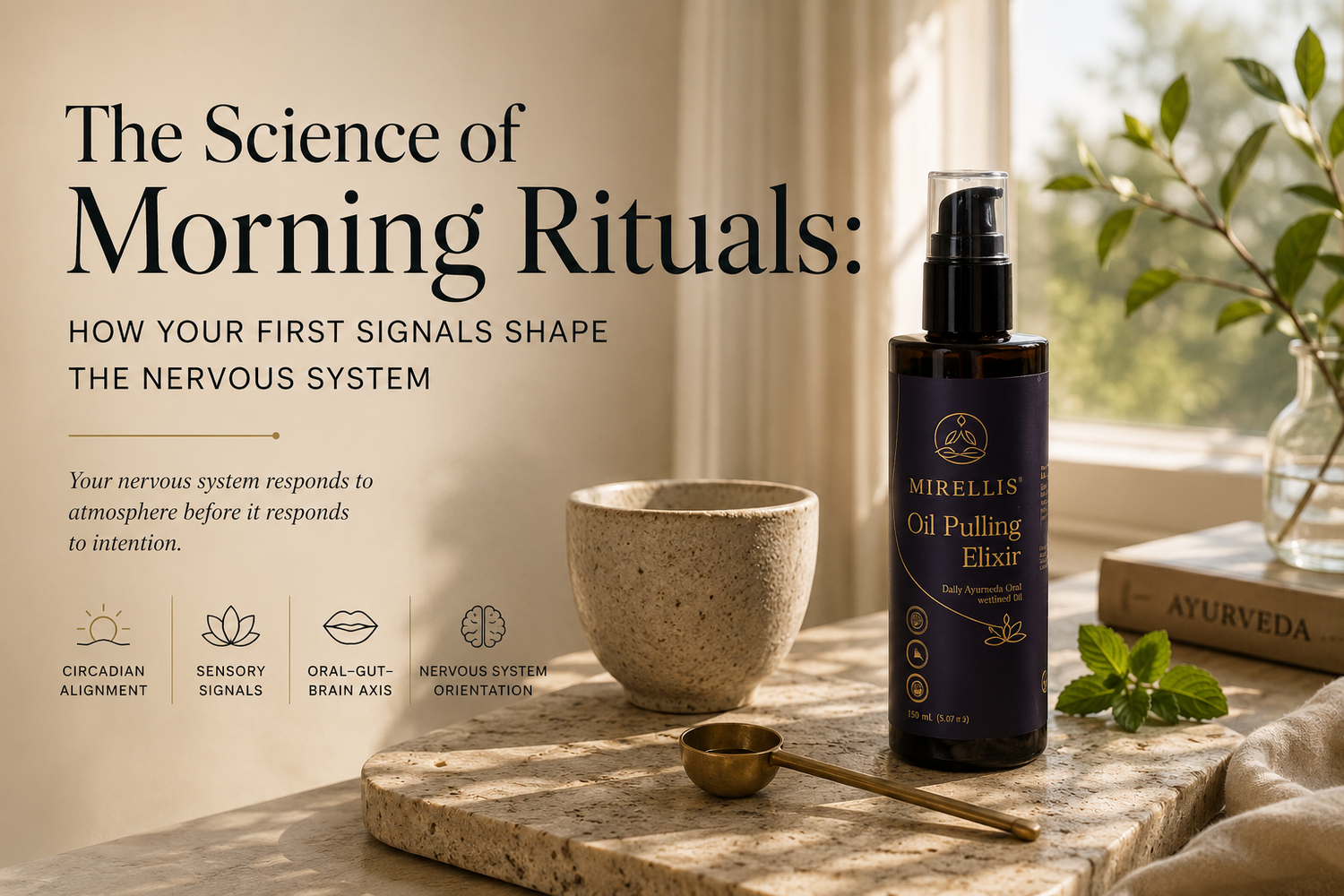
The Science of Morning Rituals: How Your First Signals Shape the Nervous System
Your nervous system responds to atmosphere before it responds to intention.
Most people think mornings begin with decisions.
Coffee. Notifications. Productivity. Planning.
But biologically, the morning starts much earlier than that.
Before conscious thought fully arrives, the nervous system is already scanning for cues:
light,
temperature,
sound,
breath,
movement,
predictability,
and the sensory signals that tell the body what kind of day it is entering.
This is why the first moments of the morning often shape the emotional tone of the entire day more than we realize.
Modern life tends to interrupt this process immediately.
Phones are checked before sunlight.
Notifications arrive before silence.
Mental stimulation begins before the body has fully oriented itself.
And over time, the nervous system stops experiencing mornings as a gradual awakening.
It experiences them as an abrupt activation.
The result is subtle but cumulative:
mental fog,
irritability,
restlessness,
emotional reactivity,
fatigue that appears unusually early,
and a growing sense that the mind wakes up already overstimulated.
Ancient ritual systems understood something modern life often forgets:
the body responds deeply to repeated sensory patterns.
Not dramatic transformations.
Not optimization hacks.
But consistent biological signals.
Morning rituals were never only symbolic.
They were physiological orientation systems.
Why the Nervous System Depends on Predictable Morning Signals
The nervous system is constantly interpreting environment.
Long before conscious analysis, the brain is asking:
Am I safe?
Am I rushed?
Am I overstimulated?
Am I grounded?
What state should I prepare for?
These interpretations happen through sensory input.
The quality of light entering the eyes.
The rhythm of breathing.
The pace of movement.
The sounds in the environment.
The feeling inside the mouth and body after waking.
Repeated consistently, these cues shape nervous system behavior over time.
This is one reason predictable rituals often feel calming even when they are simple.
The body learns patterns through repetition.
When mornings become chaotic, fragmented, and highly stimulating, the nervous system loses that sense of orientation.
Instead of gradually transitioning into wakefulness, it is pushed abruptly into alertness.
There is a difference between awakening and activation.
Modern culture often confuses the two.
The Biological Importance of Morning Transitions
The body is highly sensitive during transition states.
Waking up is one of the most neurologically significant transitions of the day.
At this time, several physiological systems begin adjusting simultaneously:
- cortisol naturally rises
- body temperature slowly increases
- alertness pathways activate
- digestion prepares to initiate
- circadian signals shift the brain toward wakefulness
This process is known as the cortisol awakening response.
Contrary to popular belief, cortisol itself is not inherently harmful.
In healthy rhythms, morning cortisol helps:
- create alertness
- improve orientation
- support cognitive clarity
- prepare the body for daytime activity
Problems emerge when the nervous system receives excessive stimulation too early.
Bright screens,
stressful information,
urgent communication,
noise,
rushing,
and fragmented attention can amplify this transition unnaturally.
The nervous system begins the day in defensive activation instead of coherent wakefulness.
This often creates the strange modern feeling of:
“tired but mentally overstimulated.”
The First Signals of the Day Shape Mental State
Why the Brain Responds to Sensory Cues Before Thoughts
The nervous system does not wake up through logic.
It wakes up through signals.
Before conscious thinking fully stabilizes, the brain is already processing:
- light exposure
- smell
- oral sensation
- sound frequencies
- breathing rhythm
- environmental predictability
This is why mornings feel profoundly different depending on environment.
A rushed, noisy morning creates one physiological experience.
A slower, quieter, more intentional morning creates another.
The difference is not only emotional.
It is neurological.
Studies in chronobiology and nervous system regulation increasingly show that repeated environmental cues shape stress responses, emotional regulation, and cognitive clarity throughout the day.
The body learns what to expect from repetition.
Why Modern Mornings Feel Mentally Loud
Many people wake up already mentally fatigued.
Not because the day has started badly,
but because the nervous system never fully completed its transition into rest the night before.
Then the cycle continues immediately upon waking:
- phone checking
- information overload
- artificial light
- rapid context switching
- emotional stimulation
- urgency exposure
The brain enters fragmented attention before coherent orientation has occurred.
Over time, this conditions the nervous system into chronic anticipatory activation.
The mind becomes constantly “prepared” for interruption.
This is one reason slower mornings often feel emotionally uncomfortable at first.
The nervous system becomes accustomed to stimulation as a regulating mechanism.
Silence can initially feel unfamiliar.
Stillness can feel unproductive.
But biologically, slower transitions often allow the brain to regulate more coherently.
The Oral–Gut–Brain Connection
Why the Mouth Shapes the Morning
One of the most overlooked aspects of morning physiology is the condition of the mouth after sleep.
During the night:
- saliva production decreases
- oral bacteria accumulate
- microbial activity changes
- the mouth becomes biologically stagnant
This is a normal process.
But the first sensory interactions of the morning influence how the body experiences awakening.
In Ayurveda, practices like oil pulling were traditionally performed before food, stimulation, or conversation.
Not as cosmetic rituals,
but as cleansing and orienting practices.
Modern research increasingly supports the importance of the oral microbiome in broader systemic health.
The mouth is not isolated from the rest of the body.
It exists in constant communication with:
- digestion
- inflammation pathways
- immune signaling
- even aspects of neurological health
This is often referred to as the oral–gut–brain axis.
What Oil Pulling Actually Does
Oil pulling involves swishing oil inside the mouth for several minutes before rinsing and brushing.
Traditionally practiced with sesame oil or coconut oil, the ritual was intended to:
- cleanse the mouth
- support gum health
- freshen breath
- reduce oral stagnation
- prepare the body for the day
From a scientific perspective, oils interact with oral debris, bacterial biofilm, and lipid-soluble impurities inside the mouth.
Certain oils — particularly coconut oil and sesame oil — also contain naturally antimicrobial compounds.
Research has shown that regular oil pulling may help reduce:
- plaque accumulation
- harmful oral bacteria
- gum irritation
- unpleasant breath
But beyond mechanics, the ritual itself matters.
Oil pulling creates a pause before stimulation.
A slower sensory beginning.
A moment where the nervous system awakens gradually rather than abruptly.
Why Slow Mornings Affect Emotional Regulation
The Nervous System Learns Through Repetition
The nervous system adapts to repeated environments.
Not occasionally.
Repeatedly.
A single calm morning will not transform physiology.
But repeated sensory pacing can slowly influence:
- emotional regulation
- stress reactivity
- mental clarity
- nervous system predictability
This is one reason rituals matter psychologically.
The body begins associating repeated signals with certain states.
Over time, slower mornings can become associated with:
- clarity
- safety
- groundedness
- emotional steadiness
- reduced internal urgency
This is not about perfection.
It is about rhythm.
Morning Clarity Is Not Hyper-Productivity
Modern wellness culture often treats mornings as optimization windows.
Wake earlier.
Do more.
Track more.
Stimulate more.
Perform more.
But biologically, excessive activation is not always clarity.
Sometimes clarity is simply coherent awakening.
A nervous system that has not been rushed into fragmentation.
A body that has been allowed to orient gradually.
A mind that enters the day instead of colliding with it.
Building a More Regulating Morning Ritual
Simple Signals That Support Nervous System Orientation
A regulating morning does not need to be elaborate.
Often, the most effective signals are the simplest.
Light Exposure
Natural morning light helps reinforce circadian rhythm and wakefulness pathways.
Even a few minutes of daylight exposure can support:
- alertness
- mood regulation
- sleep quality later in the evening
Breath Awareness
Slower nasal breathing can reduce unnecessary physiological tension during awakening.
Even brief moments of conscious breathing help reduce fragmented activation.
Reduced Immediate Stimulation
Delaying notifications, social media, or stressful information for even a short period can change the emotional texture of the morning significantly.
Oral Cleansing Rituals
Practices like oil pulling create sensory freshness while reinforcing intentional pacing.
The ritual becomes both biological and psychological.
Sound and Environment
Gentler soundscapes, quieter spaces, warm natural light, and slower pacing all influence how the nervous system interprets the start of the day.
Rituals Are Biological Language
Why Repetition Changes the Way the Body Feels
The body responds to repeated sensory language.
Light.
Sound.
Touch.
Rhythm.
Breath.
Pacing.
Over time, rituals become physiological expectations.
This is why certain environments immediately feel calming while others feel mentally exhausting.
The nervous system remembers patterns.
Modern life often removes transition entirely.
We move instantly:
from sleep to stimulation,
from silence to information,
from rest to performance.
But biologically, the body still needs orientation.
It still responds to atmosphere.
It still depends on signals.
And perhaps this is why rituals continue to matter across generations and cultures.
Not because the body loves complexity.
But because the nervous system has always depended on rhythm.
A More Intentional Beginning
Morning rituals are not about perfection.
They are not about aesthetic routines or productivity performance.
At their best, they are simply ways of helping the body transition more coherently into the day.
A quieter beginning.
A slower breath.
A cleaner sensory state.
A more predictable rhythm.
Small signals repeated consistently.
Because the nervous system often responds to the first moments of the day long before the mind realizes it.
And sometimes clarity begins not with intensity —
but with gentler beginnings.
Research Notes & Scientific References
Circadian Rhythm & Morning Physiology
Research in chronobiology shows that waking is a coordinated biological transition involving cortisol regulation, body temperature changes, alertness signaling, and circadian rhythm alignment.
References
- Clow A, Thorn L, Evans P, Hucklebridge F. The awakening cortisol response: methodological issues and significance. Stress. 2004.
https://pubmed.ncbi.nlm.nih.gov/15204030/ - National Institute of General Medical Sciences — Circadian Rhythms
https://www.nigms.nih.gov/education/fact-sheets/Pages/circadian-rhythms.aspx - Harvard Medical School — Blue Light Has a Dark Side
https://www.health.harvard.edu/staying-healthy/blue-light-has-a-dark-side
Morning Light Exposure & Nervous System Regulation
Morning daylight exposure has been shown to influence wakefulness, mood regulation, melatonin timing, and circadian synchronization.
References
- Sleep Foundation — Morning Sunlight & Better Sleep
https://www.sleepfoundation.org/bedroom-environment/light-and-sleep - Harvard Health Publishing — Blue light and sleep
https://www.health.harvard.edu/staying-healthy/blue-light-has-a-dark-side - Frontiers in Physiology — Light Exposure and Circadian Health
https://www.frontiersin.org/articles/10.3389/fphys.2019.00963/full
Environmental Predictability & Nervous System Safety
Research in neuroscience and stress physiology suggests that repeated environmental patterns and predictability influence emotional regulation and autonomic nervous system responses.
References
- Porges SW. The Polyvagal Theory: Neurophysiological Foundations of Emotions, Attachment, Communication, and Self-Regulation.
https://wwnorton.com/books/9780393707007 - Frontiers in Psychology — Environmental Predictability and Stress Regulation
https://www.frontiersin.org/articles/10.3389/fpsyg.2015.01113/full
The Oral–Gut–Brain Axis
Emerging evidence suggests that oral microbiome balance may influence systemic inflammation, digestive health, immune signaling, and neurological pathways.
References
- NIH / NCBI — Oral Microbiota in Health and Disease
https://www.ncbi.nlm.nih.gov/pmc/articles/PMC6825549/ - Nature Reviews Gastroenterology & Hepatology — The Gut-Brain Axis
https://www.nature.com/articles/nrgastro.2016.200 - Frontiers in Cellular and Infection Microbiology — Oral–Gut Microbiome Interactions
https://www.frontiersin.org/articles/10.3389/fcimb.2021.722744/full
Oil Pulling & Oral Microbiome Research
Clinical studies on oil pulling — particularly with sesame oil and coconut oil — have demonstrated reductions in plaque accumulation, oral bacterial load, and halitosis markers in certain populations.
References
- Asokan S et al. Effect of oil pulling on plaque induced gingivitis. Indian Journal of Dental Research.
https://pubmed.ncbi.nlm.nih.gov/21157014/ - Peedikayil FC et al. Comparison of antibacterial efficacy of coconut oil and chlorhexidine on Streptococcus mutans. Journal of Contemporary Dental Practice.
https://pubmed.ncbi.nlm.nih.gov/24309313/ - Journal of Clinical and Diagnostic Research — Oil Pulling for Maintaining Oral Hygiene
https://www.ncbi.nlm.nih.gov/pmc/articles/PMC5198813/
Breath, Sensory Regulation & Parasympathetic Activation
Slow breathing practices have been associated with parasympathetic nervous system activation, reduced physiological stress response, and emotional regulation support.
References
- Frontiers in Human Neuroscience — Breathing and the Nervous System
https://www.frontiersin.org/articles/10.3389/fnhum.2018.00353/full - NIH / NCBI — Slow Breathing Techniques and Autonomic Function
https://www.ncbi.nlm.nih.gov/pmc/articles/PMC6137615/
Related Reading
- Why Your Mind Races at Night
- Why Screens and Artificial Light Delay Deep Sleep
- Why Modern Life Keeps the Brain in Stimulation Mode
-
Why the Nervous System Needs Predictability to Feel Safe
- Why Slow Mornings Change the Nervous System
- Why Breath Changes Mental Clarity
- Why Your Brain Feels Foggy in the Morning