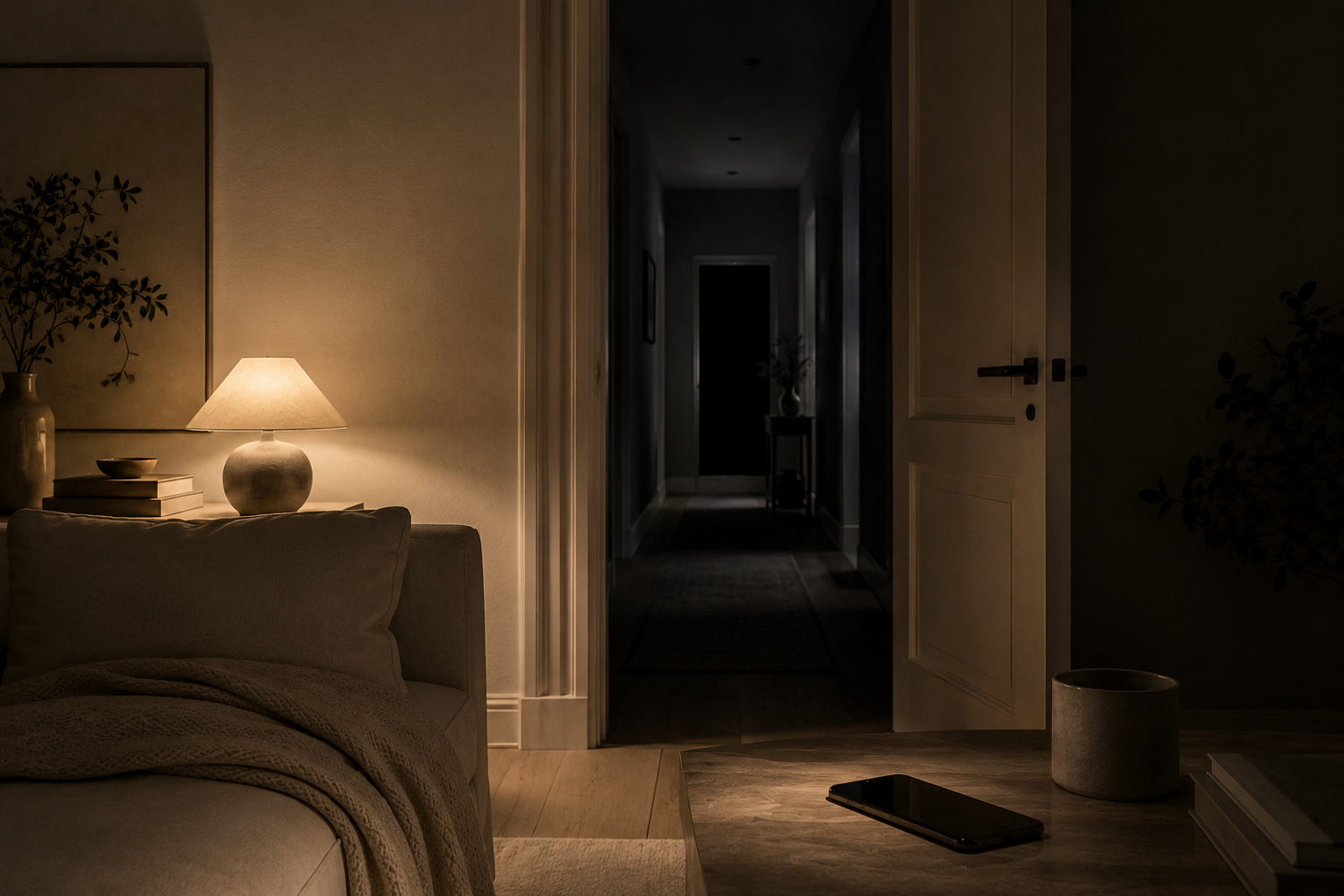
You are not scrolling because you are entertained.
You are scrolling because you cannot find the doorway out of the day.
The work is finished.
The messages have been answered.
The obligations are mostly complete.
You are tired.
You want rest.
And yet your thumb keeps moving.
One video becomes another.
One post becomes another.
One article becomes another.
You tell yourself you'll stop after this one.
Then another appears.
Then another.
Most people describe this as a phone problem.
We are not convinced that it is.
What we observed
Recently, we reviewed a collection of observations from people describing late-night scrolling, exhaustion, stress, distraction, and difficulty winding down.
What stood out was not how often people mentioned phones.
It was how rarely they described scrolling as enjoyable.
People did not say:
"I am having too much fun."
They said:
"I just want to do nothing."
They said:
"My body forgot how to downshift."
They said:
"Work ends but my system doesn't."
They said:
"Tired but wired."
Again and again, people described a strange state between activity and rest.
They were no longer working.
But they were not recovering.
They were no longer stimulated by necessity.
But they could not enter restoration.
The phone appeared repeatedly.
But the phone did not appear to be the destination.
It appeared to be the waiting room.
The missing doorway
Modern life contains many endings.
The end of a meeting.
The end of work.
The end of a commute.
The end of a conversation.
What it increasingly lacks are transitions.
Historically, transitions were often built into daily life.
The walk home.
The evening meal.
The change of environment.
The slowing of activity.
The gradual reduction of stimulation.
The nervous system received evidence that one chapter was ending and another was beginning.
Today, many of those signals have disappeared.
Work follows us home.
Notifications continue indefinitely.
The same device used for work becomes the device used for entertainment.
The same attention remains active long after the demands that activated it have passed.
The day ends physically.
It often does not end psychologically.
The phone occupies the gap
One of the most interesting observations was that many people seemed unable to identify what they were actually looking for.
They were not searching for information.
They were not searching for connection.
They were not searching for a specific piece of content.
They were searching for something harder to describe.
A way out.
A pause.
A release.
A shift.
The phone happened to be available.
So the phone occupied the space.
Not because it solved the problem.
Because it filled the gap.
The scroll became a substitute for a transition.
This is not a content problem
Most discussions about late-night scrolling focus on content.
Too much content.
Too much stimulation.
Too much dopamine.
Too much screen time.
There may be truth in all of those explanations.
But the observations suggest something deeper.
Many people already know they should stop.
They know sleep would feel better.
They know the content is no longer serving them.
Yet they continue.
This pattern should sound familiar.
It appeared in our earlier observations about sleep.
It appeared in our observations about mornings.
Knowledge was not missing.
The challenge existed somewhere else.
This is not a content problem.
It is a transition problem.
What restoration actually requires
Restoration is not the absence of activity.
It is the presence of a signal.
A signal that says:
The work is finished.
The vigilance is no longer required.
Nothing more needs to happen tonight.
The nervous system can stop looking.
The form that signal takes may differ from person to person.
For some it may be a walk.
For others, music.
For others, journaling.
A shower.
Silence.
A ritual.
The activity matters less than its function.
Its purpose is not entertainment.
Its purpose is transition.
It creates a bridge between stimulation and restoration.
Why we continue to study this
At Mirellis, we continue to observe the places where modern life seems to lose its transitions.
The move from sleep to wakefulness.
The move from work to recovery.
The move from stimulation to restoration.
Again and again, the observations point toward the same possibility:
Human beings struggle most at the boundaries between states.
Not inside them.
Our evening formulation, Stillness Elixir, was created as one possible signal within this transition.
Not as a cure for scrolling.
Not as a productivity tool.
Not as a sleep aid.
But as a deliberate marker that one state is ending and another is beginning.
The formulation is less interesting than the question it serves:
What helps a human being stop carrying the day into the night?
An open observation
Perhaps the problem is not that you cannot stop scrolling.
Perhaps the problem is that nothing ever told your nervous system the day was over.
Perhaps the phone is not the destination.
Perhaps it is where people wait when the doorway out of the day has disappeared.
—
Observatory Finding 003 (Preliminary)
Across early observations, people describing late-night scrolling rarely described it as entertainment-seeking.
Instead, they described difficulty moving from stimulation into restoration.
The phone appeared not as the destination, but as a placeholder occupying the space where a transition should have been.
This is not a content problem.
It is a transition problem.
RITUAL TOOL — STIMULATION → RESTORATION
Stillness Elixir
The signal that the day is finished. Applied in the evening when stimulation has run its course and the nervous system needs permission to begin restoration.
Explore the ritual tool →