Introduction
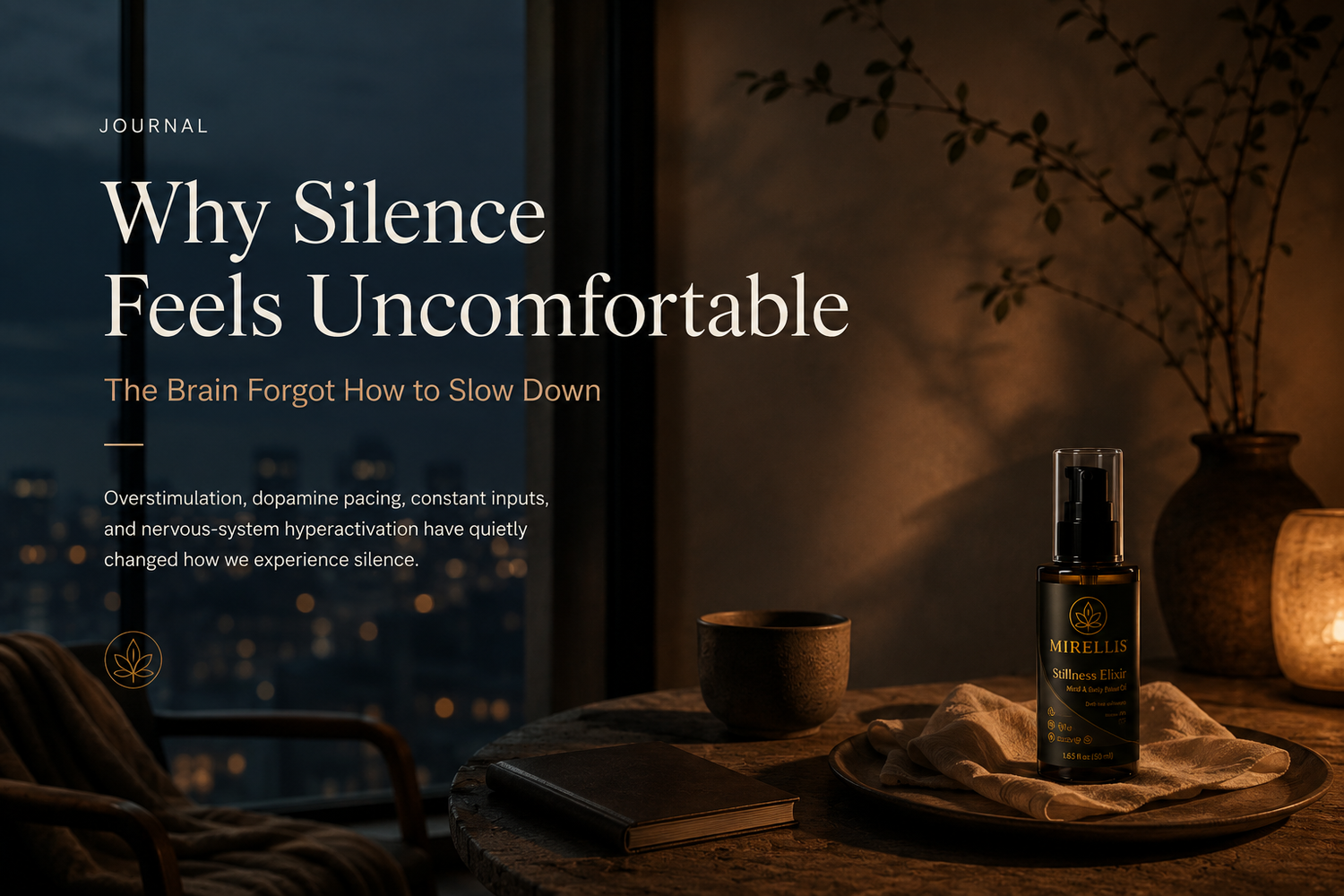
For many people today, silence no longer feels relaxing.
Instead, it can feel:
- uncomfortable,
- emotionally loud,
- mentally restless,
- or even slightly unsettling.
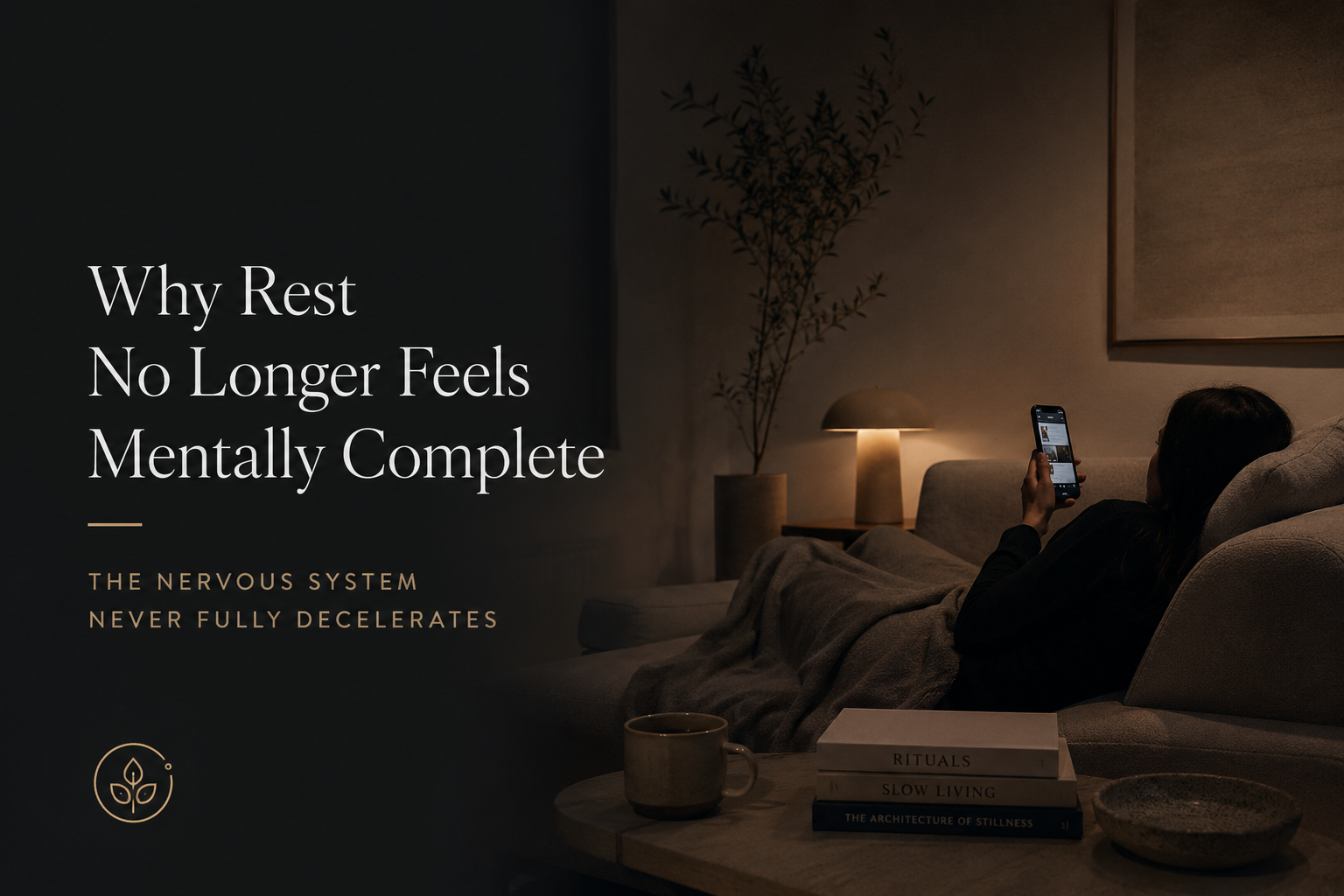
Moments without stimulation — no scrolling, no music, no notifications, no conversation, no background noise — can quickly create an urge to reach for a phone, turn something on, check a message, or fill the space with input.
This reaction is becoming increasingly common in modern environments.
And importantly, it does not necessarily mean something is “wrong” with the individual.
The human nervous system adapts to repeated environments.
When the brain becomes accustomed to continuous stimulation, silence can begin to feel unfamiliar. And unfamiliar states are often interpreted by the nervous system as psychologically uncomfortable — even when they are not dangerous.
Modern life exposes the brain to an unprecedented level of continuous sensory input:
- notifications,
- short-form content,
- rapid information switching,
- algorithmic novelty,
- constant background media,
- multitasking,
- and perpetual attentional engagement.
Over time, many people lose regular exposure to environments with:
- slower pacing,
- uninterrupted stillness,
- reduced sensory load,
- and sustained quiet attention.
As a result, silence itself can begin to feel psychologically intense.
The Brain Learns Through Repetition
The nervous system is highly adaptive.
Repeated environments gradually become the brain’s “baseline” expectation for normal experience.
When a person spends years surrounded by:
- constant digital stimulation,
- rapid attentional switching,
- background media,
- and continuous information flow,
the brain slowly adjusts to operating within high-input conditions.
This adaptation affects:
- attention,
- emotional pacing,
- dopamine signaling,
- cognitive arousal,
- and nervous-system regulation.
In neuroscience, this is sometimes described through concepts like habituation and neuroadaptation — where repeated exposure changes how the brain processes stimulation over time.
Importantly, the brain does not only adapt to substances or extreme experiences.
It also adapts to:
- environmental intensity,
- sensory pacing,
- novelty frequency,
- and cognitive load.
The more continuously stimulated the nervous system becomes, the more unfamiliar low-stimulation environments can feel.
Modern Environments Rarely Allow Cognitive Quiet
Historically, silence and lower sensory stimulation were built more naturally into daily life.
Moments of:
- walking,
- waiting,
- eating,
- resting,
- traveling,
- and evening transitions
often contained periods of reduced input.
Today, many of those spaces have become filled with stimulation.
Phones accompany people:
- while eating,
- during transitions,
- in bed,
- during commutes,
- while walking,
- and even during brief pauses between tasks.
The brain now experiences fewer moments of:
- uninterrupted reflection,
- sensory reduction,
- and attentional stillness.
This matters because the nervous system relies on fluctuations in stimulation to regulate itself.
Without periods of lower input, the brain remains in a more continuously activated state.
Dopamine and Constant Novelty
One reason silence can feel uncomfortable is that modern digital environments repeatedly train the brain around novelty-based reward systems.
Dopamine is often misunderstood as simply a “pleasure chemical,” but neuroscientifically it is more strongly associated with:
- motivation,
- anticipation,
- reward prediction,
- novelty seeking,
- and attentional engagement.
Modern platforms are highly effective at continuously triggering these systems through:
- unpredictable rewards,
- infinite scrolling,
- rapid novelty,
- notifications,
- social validation,
- and constant informational variation.
This creates repeated cycles of anticipation and stimulation.
Over time, quieter environments can begin to feel comparatively under-stimulating.
The issue is not necessarily addiction in a dramatic sense.
More often, it is a gradual shift in baseline nervous-system pacing.
The brain becomes increasingly accustomed to:
- frequent input,
- rapid transitions,
- and continuous attentional occupation.
In silence, the sudden absence of stimulation can feel psychologically uncomfortable simply because the nervous system has adapted to constant engagement.
Silence Increases Awareness
Silence also changes what becomes noticeable internally.
During periods of constant stimulation, attention remains externally occupied:
- content,
- conversations,
- media,
- work,
- updates,
- and tasks continuously direct focus outward.
In silence, however, internal experiences often become more visible.
People may suddenly become more aware of:
- unresolved thoughts,
- emotional fatigue,
- anxiety,
- loneliness,
- uncertainty,
- physical tension,
- overstimulation,
- or mental exhaustion.
This is one reason some people feel mentally “louder” in quiet environments.
The silence itself is not creating the discomfort.
It is reducing distraction.
And when distraction decreases, accumulated internal load becomes easier to notice.
Hyperstimulation Changes Nervous-System Pacing
The nervous system constantly adjusts its expectations based on repeated environmental rhythm.
Fast-paced stimulation creates a different internal tempo.
When people repeatedly consume:
- rapid edits,
- short-form videos,
- fragmented information,
- multitasking environments,
- constant messaging,
- and background media,
the brain gradually adapts to faster attentional cycling.
Silence, by contrast, contains:
- less novelty,
- slower pacing,
- reduced prediction,
- and lower informational density.
For a nervous system conditioned toward high stimulation, this slower rhythm can initially feel uncomfortable rather than calming.
This does not mean the brain is incapable of slowing down.
But it may mean the nervous system has had limited recent exposure to slower states.
The Nervous System Interprets Safety Through Familiarity
The brain often experiences familiar environments as safer than unfamiliar ones.
If constant stimulation becomes psychologically familiar, stillness may temporarily feel unfamiliar.
And unfamiliar nervous-system states can create subtle discomfort.
This is important because many people incorrectly assume:
“If silence feels uncomfortable, it must mean I’m bad at relaxing.”
In reality, the nervous system may simply be deconditioned from lower-stimulation environments.
Much like physical muscles adapt to repeated movement patterns, attentional systems also adapt to repeated sensory pacing.
Slowing down is sometimes not only emotional.
It is physiological retraining.
Why Many People Constantly Need Background Noise
The increasing dependence on:
- podcasts,
- television,
- music,
- YouTube,
- multitasking media,
- and passive scrolling
often reflects more than simple entertainment preference.
For many people, constant background stimulation helps prevent full contact with mental stillness.
Continuous input can temporarily:
- occupy attention,
- suppress internal awareness,
- reduce emotional visibility,
- and maintain cognitive momentum.
Silence interrupts that momentum.
And when the nervous system has not practiced quiet regularly, the interruption can feel psychologically exposed.
This does not mean background sound is inherently harmful.
In many cases, sound can be deeply regulating.
But there is a difference between:
- intentional sensory environments,
and:
- constant unconscious stimulation used to avoid psychological stillness.
Silence Is Becoming a Biological Contrast State
In many modern environments, silence has become increasingly rare.
As stimulation rises across:
- digital life,
- work,
- media,
- advertising,
- transportation,
- and social environments,
quiet spaces become more biologically distinct.
The nervous system experiences contrast more intensely.
This may explain why many people simultaneously:
- crave peace,
- but struggle when they finally encounter it.
The body wants restoration.
But the nervous system may no longer know how to transition into lower stimulation smoothly.
The Nervous System Needs Gradual Deceleration
Deep rest rarely happens instantly.
The nervous system often regulates more effectively through gradual sensory slowing:
- softer lighting,
- calmer sound environments,
- slower pacing,
- reduced notifications,
- repetitive rituals,
- quieter spaces,
- and reduced attentional fragmentation.
This is one reason evening rituals, slower environments, reading, reflective walks, ambient music, and intentional silence can feel restorative over time.
Not because silence is magical,
but because the nervous system slowly relearns how to tolerate lower stimulation safely.
Modern Silence Feels Different
Silence today exists within a very different psychological environment than it once did.
Many people now live within:
- continuous informational exposure,
- fragmented attention,
- persistent digital connection,
- and constant cognitive occupation.
As a result, silence can begin to feel emotionally amplified.
But often, the discomfort is not caused by silence itself.
It is caused by what prolonged overstimulation has done to the nervous system’s baseline expectations.
Final Reflection
The modern nervous system is adapting to environments filled with:
light,
noise,
novelty,
notifications,
information,
and continuous attention capture.
In that context, silence can begin to feel unfamiliar.
And unfamiliar states often feel uncomfortable before they feel restorative.
Many people are not incapable of slowing down.
They may simply be living in environments that rarely allow the nervous system to practice stillness anymore.
Over time, repeated moments of quieter pacing, reduced stimulation, and intentional sensory slowing can gradually help the brain remember what uninterrupted calm once felt like.
Sometimes the difficulty is not silence itself.
It is how long the nervous system has gone without it.