The Modern Experience of Being “Off” Without Ever Fully Slowing Down
There is a kind of exhaustion that has become so common it is rarely questioned anymore.
Not dramatic burnout. Not collapse. Not insomnia severe enough to feel medical. Something quieter than that. More ambient. More difficult to name.
The feeling of technically resting without ever fully recovering.
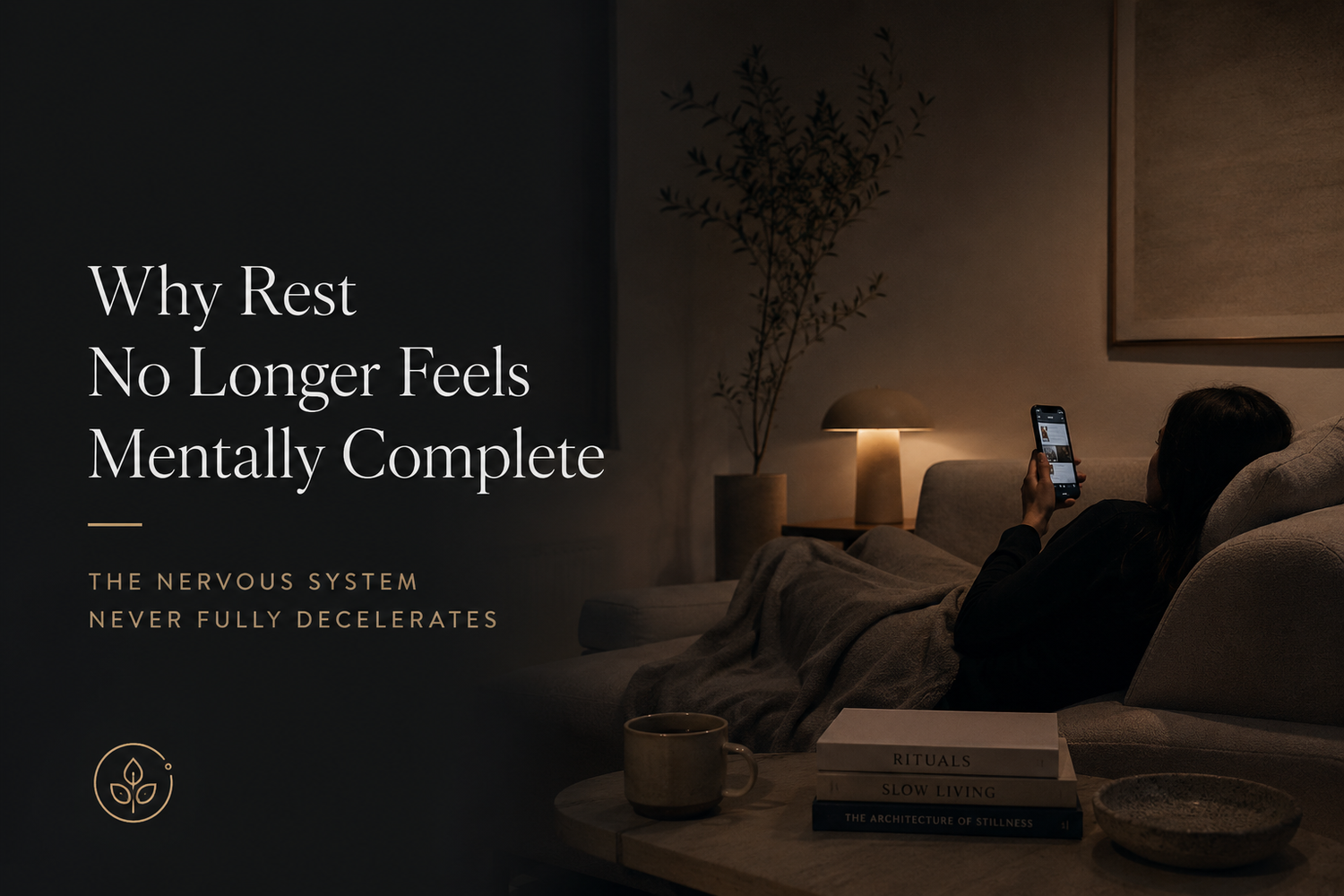
An evening spent lying on the couch while scrolling endlessly through fragments of information. Watching something while simultaneously checking messages. Closing the laptop while the nervous system continues replaying unfinished conversations, unresolved tasks, and low-grade emotional residue long after the body has stopped moving.
Many people today are no longer deprived only of sleep.
They are deprived of psychological completion.
The body may be physically inactive, but the nervous system never fully receives the signals that the day is over.
And this distinction matters more than it initially appears.
Because human restoration does not occur simply through the absence of work. Restoration requires a transition into states where the nervous system no longer feels responsible for monitoring, processing, anticipating, updating, and responding.
Modern life increasingly interrupts that transition.
The Difference Between Physical Rest and Nervous System Rest
Historically, rest was not simply the opposite of labor. It was a physiological and environmental state.
Light levels changed. Social rhythms slowed. Sound environments softened. Cognitive stimulation reduced naturally because there were fewer mechanisms capable of continuously extending attention into the night.
The nervous system evolved within environments that contained endings.
Sunset represented a sensory transition. Communities slowed together. Darkness imposed boundaries on activity. The body encountered predictable sequences that helped it shift gradually from vigilance toward restoration.
Today, those endings have largely disappeared.
The modern evening often remains psychologically active long after physical activity declines.
A person may technically “stop working,” but continue consuming information continuously for hours:
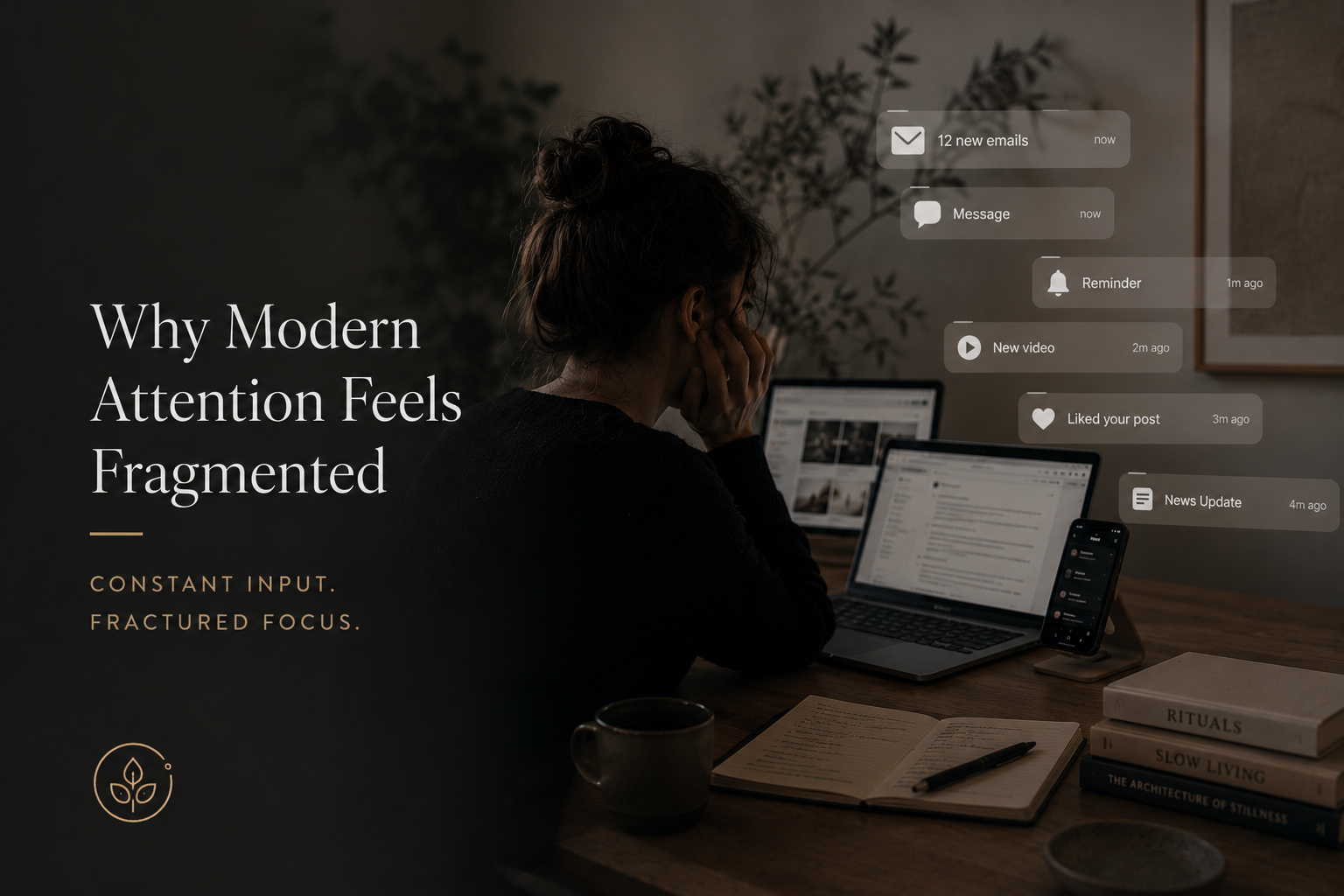
- notifications,
- scrolling,
- videos,
- fragmented conversations,
- background noise,
- emotional processing,
- unfinished cognitive loops.
The body is still.
The nervous system is not.
This is one reason many people describe a peculiar form of exhaustion:
“I rested all evening, but I still feel mentally tired.”
From a physiological perspective, the nervous system may never have fully transitioned into restoration at all.
Why Passive Stimulation Still Exhausts the Brain
One of the most misunderstood aspects of modern fatigue is the assumption that exhaustion only comes from active effort.
But the brain expends energy not only through intense concentration. It also expends energy through continual monitoring and processing.
Scrolling while exhausted still requires:
- attentional shifts,
- novelty detection,
- emotional interpretation,
- micro-decisions,
- sensory updating,
- and predictive processing.
Even passive digital consumption recruits the brain’s salience networks repeatedly.
Every new image, headline, notification, emotional tone, or unexpected piece of information creates a small act of neurological orientation.
The brain asks continuously:
- What is this?
- Is it important?
- Does it require a response?
- Does it change my understanding of something?
- Should attention move here?
Most of these processes occur beneath conscious awareness.
Yet they are metabolically expensive.
Contemporary neuroscience increasingly understands the brain not as a reactive organ, but as a predictive one. The nervous system constantly generates models of what is about to happen, compares incoming information against those expectations, and adjusts accordingly.
The cost of this system is known as prediction error.
When the environment remains fragmented, novel, and unpredictable, prediction error remains elevated. The nervous system stays engaged because it cannot fully settle into stable expectations.
In simpler terms:
the brain continues preparing for the possibility that something important is about to happen.
This is why endless low-level stimulation can become so exhausting.
Not because any individual input is overwhelming —
but because the nervous system never stops orienting.
The Cognitive Continuation of the Modern Evening
Many evenings no longer feel psychologically distinct from the day itself.
This may be one of the defining nervous system conditions of modern life.
Historically, transitions between states were clearer:
- work and home,
- activity and stillness,
- social engagement and solitude,
- daylight and darkness.
Modern technology collapsed many of these boundaries.
The same device used for work delivers entertainment.
The same screen used for communication delivers news, conflict, stimulation, advertising, and emotional exposure.
The same physical space often contains both labor and rest.
As a result, the nervous system receives fewer signals that one mode of existence has ended and another has begun.
The day continues cognitively even after it ends chronologically.
This phenomenon might be described as cognitive continuation:
the persistence of low-grade mental activation long after active responsibilities are complete.
The nervous system remains partially vigilant because the environment continues behaving as though engagement is still required.
The result is subtle but profound:
- evenings feel less restorative,
- sleep feels less psychologically complete,
- mornings begin with residual cognitive fatigue,
- and mental exhaustion accumulates gradually across days.
Not necessarily because people are working more hours —
but because the nervous system no longer experiences clear psychological descent.
Why Mental Rest Requires Environmental Signals
The nervous system does not respond only to intention.
It responds to environment.
Before conscious thought enters the equation, the brain has already begun interpreting:
- light,
- sound,
- temperature,
- movement,
- pacing,
- visual complexity,
- social stimulation,
- and sensory rhythm.
The environment functions as biological instruction.
Bright, rapidly changing sensory environments communicate one kind of message:
remain alert.
Slower, quieter, lower-stimulation environments communicate another:
deceleration is possible.
This is why certain spaces feel mentally different before anything “happens” inside them.
A softly lit room, reduced sound, slower pacing, warmth, and visual stillness all reduce the amount of incoming sensory data the nervous system must process.
The brain interprets this reduction not merely aesthetically, but physiologically.
Safety is associated with predictability and reduced vigilance demand.
Restoration becomes easier when the nervous system no longer feels responsible for continual orientation.
The Brain Was Never Designed for Infinite Evenings
For most of human history, evenings had structure imposed by biology and environment.
Darkness limited stimulation.
Silence increased naturally.
Community rhythms slowed collectively.
Today, evenings can extend indefinitely.
Streaming platforms remove natural stopping points.
Social media creates endless novelty loops.
Notifications arrive without rhythm.
Information becomes continuously available.
The nervous system now lives inside what researchers sometimes describe as an always-on attentional environment.
This matters because attentional systems evolved for scarcity, not abundance.
Novel information activates dopamine pathways associated with orienting and reward prediction. The brain remains engaged because uncertainty itself can sustain attention.
This is not inherently pathological.
Human curiosity has always been adaptive.
The problem emerges when the nervous system rarely exits this state.
Many people now move from:
- work stimulation,
to: - digital stimulation,
to: - emotional stimulation,
to: - informational stimulation,
without meaningful nervous system descent between them.
The body eventually reaches fatigue.
But fatigue alone is not the same as restoration.
Why Exhaustion Often Increases Scrolling
An interesting paradox appears in many modern evenings:
the more mentally exhausted a person becomes, the harder it can feel to disengage from stimulation.
This initially seems irrational.
Why would an overstimulated nervous system continue seeking more input?
Part of the answer lies in the relationship between fatigue and self-regulation.
Mental exhaustion reduces executive control — the system responsible for intentional decision-making, inhibition, and attentional regulation.
At the same time, low-effort stimulation remains easily accessible.
Scrolling requires very little physical energy.
It creates continuous novelty.
It provides temporary distraction from emotional residue and unfinished thought loops.
In this way, overstimulation sometimes becomes self-perpetuating.
The nervous system seeks relief through low-effort distraction, but the distraction itself prevents deeper restoration.
The person feels:
- tired,
- overstimulated,
- emotionally unfinished,
yet continues consuming information because stopping completely feels strangely uncomfortable.
This is not simply lack of discipline.
It reflects a nervous system that has become highly accustomed to continuous input.
Silence and Stillness Can Initially Feel Uncomfortable
One of the quieter consequences of chronic stimulation is that silence itself can begin to feel psychologically unfamiliar.
When the nervous system adapts to constant sensory occupation, the absence of input may initially increase awareness of:
- unresolved emotion,
- cognitive residue,
- internal tension,
- or accumulated mental fatigue.
This is one reason many people instinctively reach for stimulation during moments of stillness.
The stimulation is not always sought because it is pleasurable.
Sometimes it is sought because it prevents contact with unprocessed mental space.
The modern nervous system often oscillates between:
- overstimulation,
and: - avoidance of stillness.
But restoration requires some degree of perceptual quiet.
Not dramatic silence.
Not isolation.
Simply enough reduction in incoming demand for the nervous system to stop orienting constantly toward external signals.
The Biology of Deceleration
The nervous system does not contain an instant off-switch.
It operates through gradients.
Cortisol does not disappear immediately after work ends.
Sympathetic activation does not instantly collapse into parasympathetic restoration.
The body requires transition.
This is one reason evenings matter neurologically.
The hours before sleep are not passive waiting periods.
They are physiological preparation windows.
Light exposure influences melatonin timing.
Sound environments influence autonomic tone.
Activity levels affect body temperature regulation.
Sensory pacing influences arousal systems.
The nervous system begins interpreting the probability of rest long before sleep itself begins.
When evenings remain cognitively loud, brightly lit, emotionally fragmented, and continuously stimulating, the nervous system receives conflicting information:
- the body is exhausted,
but: - the environment still appears active.
The result can feel like:
- mental tiredness without psychological completion,
- physical fatigue without emotional slowing,
- or sleep that restores the body more than the mind.
What Complete Rest Actually Feels Like
This is worth describing carefully because many people have partially forgotten the feeling.
Mentally complete rest does not necessarily feel euphoric.
It often feels:
- quieter,
- slower,
- less internally crowded.
Attention softens.
The nervous system stops scanning constantly for the next input.
Thoughts lose urgency.
The body no longer feels subtly braced.
There is less internal fragmentation.
Importantly, this state usually emerges gradually.
Not through force.
Not through optimization.
Not through “trying harder” to relax.
But through environments and sequences that allow the nervous system to recognize:
nothing more is being asked of you right now.
This recognition is physiological before it is intellectual.
Why Rituals Matter More Than They Initially Appear
Rituals are often misunderstood as aesthetic or symbolic behaviors.
But from the perspective of nervous system regulation, rituals function as repeated sensory sequences.
They reduce unpredictability.
They create recognizable transitions.
They establish environmental continuity.
When the same slower behaviors, sounds, lighting conditions, scents, or rhythms consistently precede rest, the nervous system begins associating those sensory patterns with deceleration.
Over time, the body starts slowing earlier.
Not because the ritual is magical.
Because the nervous system learned the sequence.
This is one reason predictable evening environments can feel disproportionately calming.
The body responds not only to the present moment, but to repeated environmental memory.
Modern Restoration Requires Intentional Architecture
Historically, environmental transitions happened more automatically.
Today, many people must create them deliberately.
This does not necessarily require elaborate routines or extreme wellness practices.
Often the nervous system responds most strongly to relatively simple forms of sensory coherence:
- dimmer lighting,
- slower pacing,
- quieter sound environments,
- repeated evening rhythms,
- reduced informational input,
- tactile warmth,
- less fragmented attention.
The goal is not perfection.
The goal is reducing the amount of orientation the nervous system must continuously perform.
In many ways, modern restoration has become an architectural problem.
Not merely an individual discipline problem.
Why This Matters Beyond Sleep
Incomplete mental rest affects more than nighttime recovery.
When the nervous system rarely experiences full deceleration, the effects often accumulate subtly:
- cognitive fatigue,
- emotional irritability,
- attentional fragmentation,
- reduced patience,
- low-grade anxiety,
- diminished psychological spaciousness.
Over time, exhaustion begins feeling less acute and more ambient.
People stop noticing how activated they are because activation becomes normal.
This may be one reason so many individuals describe feeling:
- “constantly mentally occupied,”
- “unable to fully switch off,”
- or “tired in a way sleep alone doesn’t solve.”
The nervous system is not merely asking for unconsciousness.
It is asking for environments that permit decompression before unconsciousness arrives.
Conclusion
Modern exhaustion is not always the result of doing too much.
Sometimes it emerges from never fully stopping.
The nervous system evolved within environments containing rhythm, transitions, predictability, and sensory descent. Many modern environments now extend stimulation indefinitely — cognitively, emotionally, visually, and socially.
As a result, many people experience a form of partial restoration:
enough inactivity to become physically tired,
but not enough psychological quiet for the nervous system to fully settle.
Rest becomes incomplete.
The body lies down.
The mind continues.
And slowly, over time, mental exhaustion accumulates not because the nervous system lacks sleep entirely —
but because it rarely receives the conditions required to feel finished with the day.
The question is no longer only:
“How many hours did you sleep?”
But also:
“Did the nervous system ever truly stop orienting?”