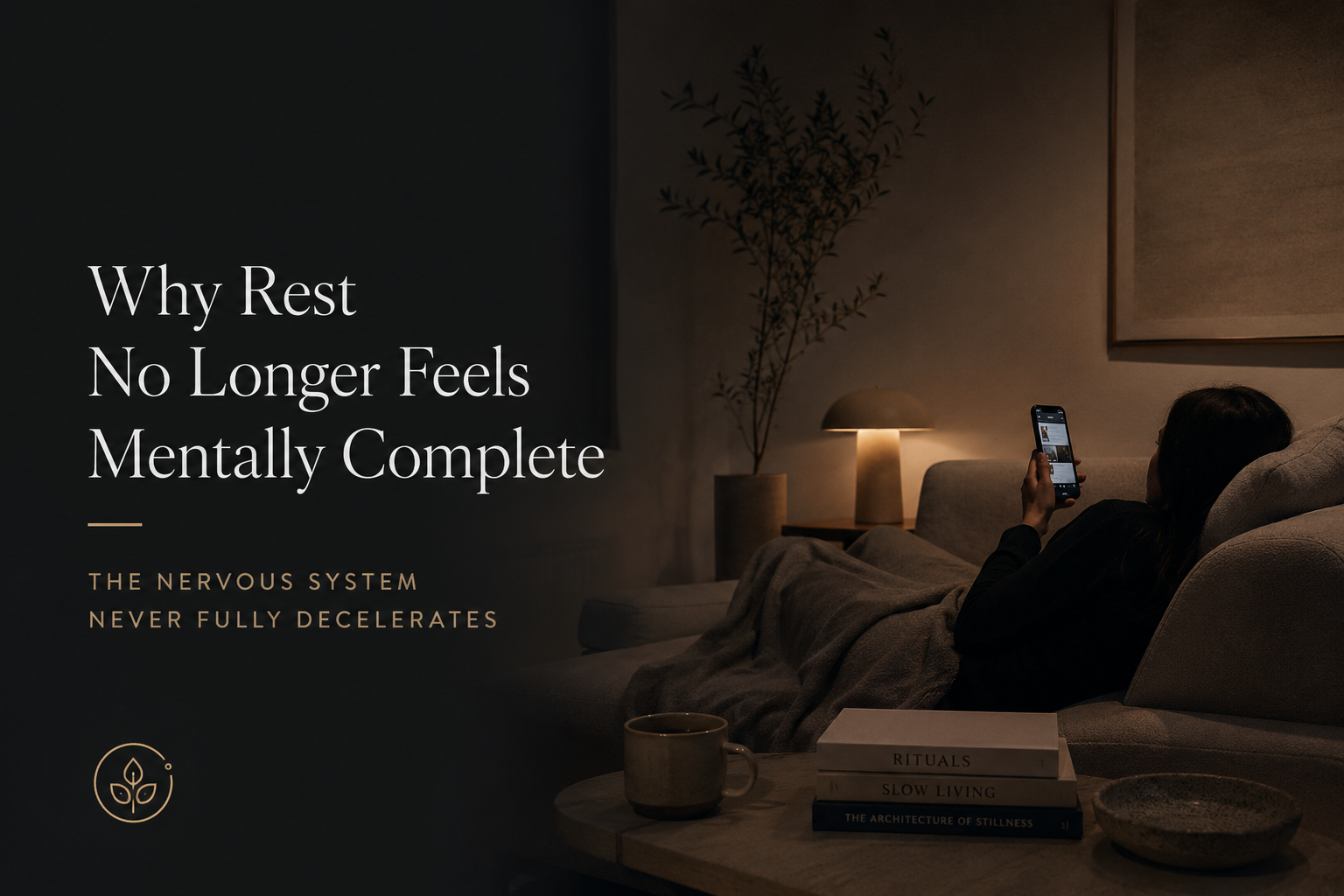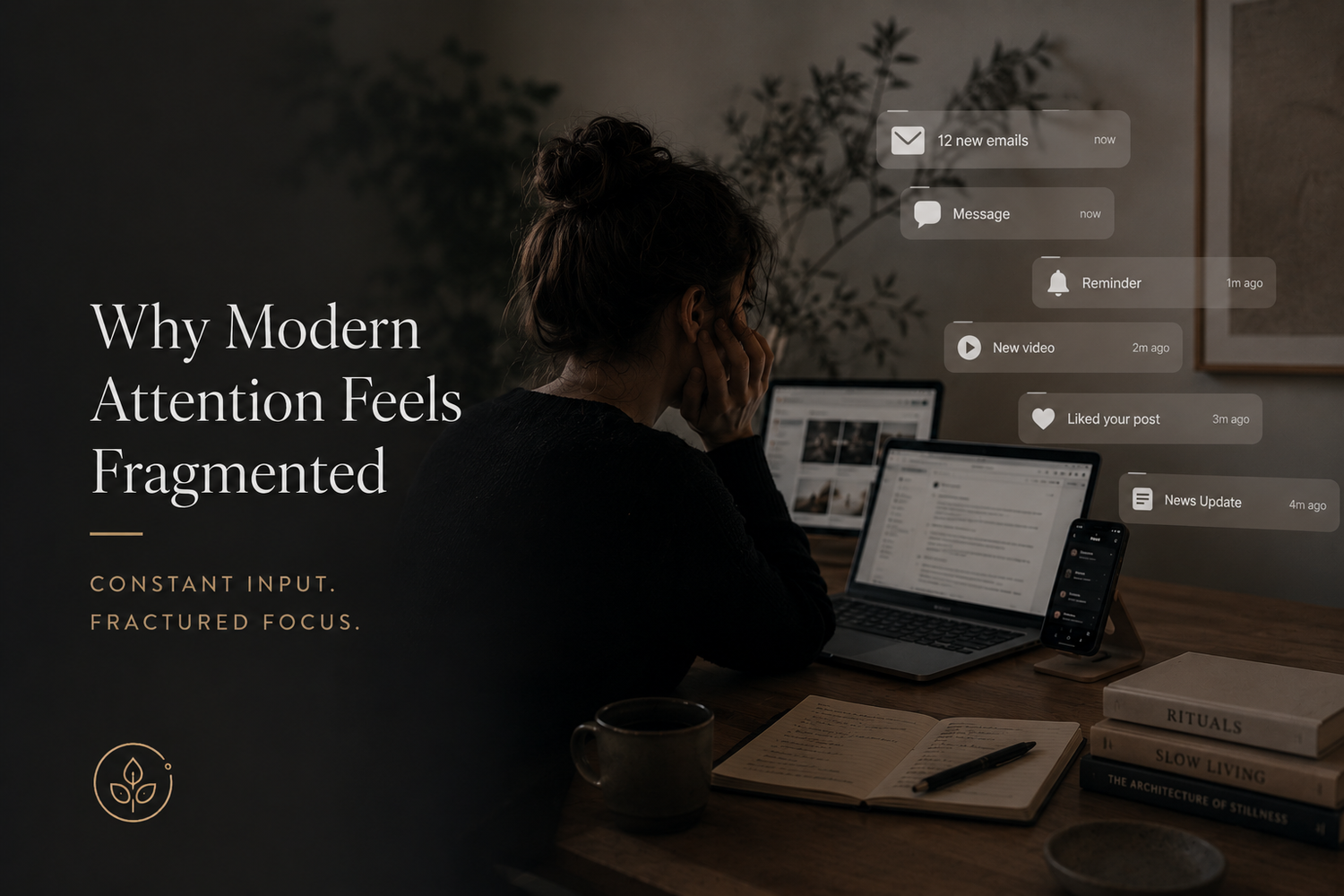
The Nervous System Was Not Designed for Continuous Context Switching
There is a particular kind of mental fatigue that has become so normal many people no longer recognize it as fatigue.
It does not always feel dramatic.
Sometimes it appears as:
- difficulty concentrating on one thing for long periods,
- opening multiple tabs without finishing any,
- rereading the same paragraph repeatedly,
- checking the phone during conversations,
- feeling mentally “busy” without clarity,
- or sensing that attention itself has become thinner.
Many people today are not simply overwhelmed by information.
They are experiencing fragmented attention.
A nervous system repeatedly interrupted before thought can fully settle.
This fragmentation often feels strangely invisible because modern environments reward constant responsiveness. Rapid switching appears productive. Continuous availability appears efficient. Multitasking appears adaptive.
But beneath the surface, the nervous system pays a significant physiological cost for continual interruption.
The human brain did not evolve inside environments where:
- dozens of informational streams competed simultaneously,
- notifications arrived unpredictably,
- attention shifted hundreds of times per hour,
- and cognitive closure became increasingly rare.
Modern attention is not merely overloaded.
It is continuously divided before it fully stabilizes.
Attention Was Historically More Continuous
For most of human history, the brain encountered information differently.
Sensory environments changed more slowly.
Tasks were more singular.
Conversations were less interrupted by external systems competing for attention.
Periods of monotony existed naturally.
This does not mean historical life was easier or less demanding. Human existence has always required vigilance and adaptation.
But attentional architecture was different.
The nervous system evolved within environments where:
- tasks unfolded sequentially,
- sensory pacing was slower,
- and fewer mechanisms continuously redirected cognitive orientation.
Today, attention rarely moves organically.
It is constantly pulled.
A person may begin reading an article, notice a message notification, remember an unfinished task, open another tab, check email, respond to something emotionally charged, return partially to the original task, and then encounter another interruption before the brain fully reorients.
From the outside, this appears normal.
Internally, however, the nervous system is repeatedly forced to disengage, reconfigure, and redirect cognitive resources.
This process is metabolically expensive.
The Brain Does Not Instantly Reset Between Tasks
One of the most misunderstood aspects of attention is the assumption that the brain transitions cleanly between activities.
In reality, cognition leaves residue.
Researchers sometimes refer to this phenomenon as attention residue or cognitive residue — the persistence of partial mental engagement with a previous task even after attention has supposedly moved elsewhere.
Part of the mind remains occupied.
A conversation continues internally.
An unresolved email lingers in working memory.
An unfinished decision remains partially active beneath conscious awareness.
The brain carries fragments forward.
This means rapid task-switching is not neutral.
Every interruption creates:
- disengagement costs,
- reorientation costs,
- prediction adjustments,
- and incomplete cognitive loops.
The nervous system repeatedly performs the neurological equivalent of braking and accelerating at the same time.
Over hours and days, this produces a form of attentional fatigue that many people now experience constantly without fully identifying.
The mind begins feeling crowded.
Not because one thought is overwhelming —
but because too many partial thoughts remain open simultaneously.
Why Modern Environments Keep Pulling Attention
The modern economy increasingly operates through competition for cognitive engagement.
Applications, platforms, advertising systems, and media environments are designed not merely to inform, but to retain attention for as long as possible.
Novelty plays a central role in this process.
The nervous system is biologically oriented toward detecting:
- change,
- unpredictability,
- social relevance,
- emotional intensity,
- and potential reward.
These systems evolved adaptively.
Noticing novel information historically improved survival.
But modern informational environments amplify novelty continuously.
Infinite scrolling, autoplay systems, rapid visual pacing, alerts, recommendation algorithms, and fragmented media formats all exploit attentional orientation systems already deeply embedded within human neurobiology.
Importantly, the brain does not experience every interruption as equally meaningful.
Many interruptions are subtle:
- a vibration,
- a banner,
- a visual cue,
- an unread count,
- a flashing icon.
Yet even minor signals recruit orienting responses.
The nervous system asks:
Should attention move here?
Most of the time, it does.
Even briefly.
And every brief redirection fragments continuity a little further.
The Tab-Switching Brain
Many people now live inside what might be called a tab-switching cognitive environment.
Not only literally on devices —
but psychologically.
Attention rarely remains in one place long enough to deepen fully.
The brain becomes conditioned toward scanning rather than immersion.
This matters because deep attention requires stability.
Concentration emerges when the nervous system stops expecting interruption.
A brain anticipating constant redirection remains partially vigilant.
Part of attention stays allocated toward monitoring for the next incoming signal.
This creates a subtle but important shift:
people increasingly consume information in fragments rather than inhabit thought fully.
Ideas become shorter.
Reading becomes shallower.
Patience for complexity declines.
Moments of cognitive stillness become rarer.
The nervous system adapts to fragmentation by becoming faster at switching —
but often weaker at sustained depth.
This adaptation can initially feel efficient.
Over time, however, many individuals describe:
- reduced mental clarity,
- difficulty entering flow states,
- emotional restlessness,
- and exhaustion without obvious cause.
The brain spends enormous energy continually reorienting.
Dopamine Is Not the Enemy — But Pacing Matters
Discussions about modern attention often oversimplify dopamine as something inherently negative.
This is inaccurate.
Dopamine is essential for:
- motivation,
- learning,
- reward prediction,
- curiosity,
- movement,
- and adaptive behavior.
The problem is not dopamine itself.
The problem is pacing.
Historically, reward systems operated within slower environmental rhythms. Novelty existed, but not in infinite succession.
Today, the nervous system may encounter:
- dozens of emotional shifts,
- hundreds of visual transitions,
- rapid informational variability,
- and continual micro-rewards
within very short periods of time.
This changes attentional pacing.
The brain becomes accustomed to higher rates of stimulation turnover.
As a result:
slower forms of cognition can begin feeling psychologically difficult.
Deep reading.
Quiet reflection.
Single-task concentration.
Silence.
Waiting.
Stillness.
Not because the nervous system lost the capacity for them —
but because attentional systems adapt to the environments they repeatedly inhabit.
The nervous system learns rhythm through repetition.
And modern informational rhythm is often fragmented, accelerated, and discontinuous.
Fragmented Attention Is Also a Nervous System State
Attention is not merely a cognitive phenomenon.
It is physiological.
A fragmented attentional environment often produces:
- low-grade sympathetic activation,
- vigilance,
- increased orienting behavior,
- reduced parasympathetic settling,
- and heightened sensory monitoring.
The body begins preparing continuously for interruption.
This can feel psychologically subtle:
- checking devices reflexively,
- difficulty relaxing into conversations,
- inability to fully engage with one activity,
- feeling mentally “on” even during rest.
The nervous system becomes conditioned toward anticipation.
Importantly, anticipation itself consumes energy.
The brain constantly predicts:
- what might appear next,
- what might require response,
- what information could be important,
- what social interaction might emerge.
This predictive processing is fundamental to human cognition.
But when environmental unpredictability becomes continuous, prediction systems rarely settle fully.
The result is not only distraction.
It is physiological fatigue.
Why Many People Feel Mentally Busy All the Time
A useful distinction exists between:
- active thinking,
and: - cognitive occupation.
Active thinking is intentional.
Directed.
Purposeful.
Cognitive occupation is different.
It is the feeling of carrying too many partially processed fragments simultaneously.
Modern environments generate enormous amounts of cognitive occupation.
Notifications create open loops.
Unfinished articles remain mentally present.
Conversations continue internally.
Media exposure leaves emotional traces.
Decision-making accumulates silently.
The nervous system rarely experiences informational completion.
As a result, many people no longer feel mentally empty even during inactivity.
Silence becomes filled with residual processing.
The mind keeps moving because too many cognitive fragments remain unresolved.
This is one reason modern exhaustion often feels mentally diffuse rather than physically intense.
The brain is not overwhelmed by one thing.
It is occupied by too many incomplete things at once.
The Relationship Between Attention and Environment
The nervous system does not pay attention in isolation.
It responds continuously to surroundings.
Environmental complexity influences cognitive load more than many people realize.
Visually dense spaces, layered sound environments, multiple simultaneous media streams, clutter, notifications, and rapid sensory pacing all increase the amount of information the nervous system must filter.
Filtering itself requires energy.
Attention is not simply about focusing on what matters.
It is also about suppressing what does not.
This means modern environments often exhaust attention not only through stimulation —
but through continual filtering demand.
The brain works constantly to decide:
- what to ignore,
- what to prioritize,
- what to monitor,
- and what might suddenly become important.
In quieter environments, this burden decreases.
The nervous system performs less orienting.
Less filtering.
Less prediction correction.
Attention stabilizes more naturally when sensory demand reduces.
Why Single-Tasking Feels Increasingly Difficult
Many people notice a growing discomfort with uninterrupted focus.
Reading one thing for extended periods can feel difficult.
Watching a film without checking the phone feels harder.
Conversations compete with background attention toward devices.
This is not necessarily evidence of permanent neurological damage.
It is often adaptation.
The nervous system becomes trained toward rapid attentional shifts through repetition.
And repetition shapes physiology.
Just as ritual repetition can condition the nervous system toward slowing, fragmented repetition conditions it toward scanning.
The brain learns:
- interruption is normal,
- attention should remain flexible,
- novelty may arrive at any moment.
Over time, sustained attention can begin feeling strangely effortful because the nervous system expects stimulation turnover.
This is why many people report:
- boredom intolerance,
- impatience during slower experiences,
- difficulty remaining mentally present,
- or compulsive checking behaviors even without clear necessity.
The brain begins seeking orientation cues habitually.
Fragmentation Also Changes Emotional Experience
Attention influences emotion more deeply than most people recognize.
Emotion requires processing time.
Reflection requires continuity.
Meaning-making requires enough mental stillness for experiences to integrate coherently.
Fragmented attention interrupts this process.
Emotions become partially processed.
Conversations remain mentally unfinished.
Experiences accumulate without integration.
The result is often subtle emotional crowding.
Many individuals feel:
- emotionally tired,
- mentally noisy,
- internally scattered,
without identifying one obvious cause.
The nervous system has not fully metabolized the volume of incoming experience.
Attention fragmentation therefore becomes not only a cognitive issue —
but an emotional one.
The mind remains busy because integration remains incomplete.
The Nervous System Needs Rhythms of Cognitive Continuity
Human cognition functions best not through constant intensity, but through oscillation.
Focus and release.
Engagement and restoration.
Stimulation and stillness.
Modern environments increasingly weaken these oscillations.
The brain remains partially engaged continuously.
This matters because attention deepens when the nervous system trusts continuity.
Flow states emerge when interruption probability decreases.
Creativity often appears after sustained immersion.
Psychological spaciousness grows when attentional fragmentation reduces.
The nervous system requires periods where:
- fewer inputs compete,
- pacing slows,
- and orientation demand declines.
Without these conditions, attention becomes chronically dispersed.
Why Slower Environments Feel Mentally Different
Many people notice something surprising when entering quieter spaces:
attention changes almost immediately.
Thought pacing slows.
Internal urgency softens.
Mental fragmentation decreases.
This is not merely aesthetic preference.
The nervous system responds physiologically to environmental pacing.
Slower sensory environments reduce:
- novelty frequency,
- prediction error,
- attentional switching,
- and orienting demand.
The brain no longer needs to monitor constantly for incoming shifts.
As a result, cognitive continuity becomes easier.
This may explain why:
- natural environments,
- architectural stillness,
- warm lighting,
- slower soundscapes,
- and visually restrained spaces
often feel psychologically restorative before any conscious analysis occurs.
The nervous system interprets environmental rhythm directly.
Restoration Is Increasingly an Attention Problem
Many conversations about wellness focus primarily on sleep, productivity, or stress.
But modern restoration may increasingly depend on attentional architecture.
A nervous system constantly interrupted rarely settles deeply.
Even rest periods become cognitively fragmented:
- checking messages during films,
- scrolling while eating,
- listening to podcasts while switching tasks,
- consuming multiple streams simultaneously.
The mind receives very little uninterrupted space.
And without uninterrupted space, cognitive restoration remains partial.
The issue is not technology itself.
The issue is continuity.
The nervous system requires periods where attention no longer fractures every few seconds.
Rituals Help Rebuild Cognitive Coherence
One reason rituals feel regulating is that they reduce attentional unpredictability.
Repeated sequences reduce cognitive demand.
The brain knows what comes next.
Lighting changes gradually.
Sounds repeat consistently.
Movements become familiar.
Pacing slows predictably.
The nervous system performs less monitoring.
This is why rituals can feel mentally calming even when they are simple.
The body responds not only to the ritual behavior —
but to the reduction in fragmentation surrounding it.
Coherence itself becomes restorative.
Conclusion
Modern attention is not failing because people suddenly became less disciplined.
Attention is adapting to environments built around continual interruption, rapid novelty, and fragmented pacing.
The nervous system evolved within rhythms that allowed thought to stabilize, attention to deepen, and experiences to integrate more fully.
Today, many environments continuously redirect cognition before it settles.
The result is not merely distraction.
It is cognitive fragmentation:
- partial attention,
- residual processing,
- continual reorientation,
- and nervous-system fatigue created by endless interruption.
Many people now feel mentally exhausted not because they are always thinking intensely —
but because the brain rarely experiences uninterrupted continuity long enough to fully settle into coherence.
The modern mind does not only need information.
Increasingly, it needs fewer interruptions between thoughts.