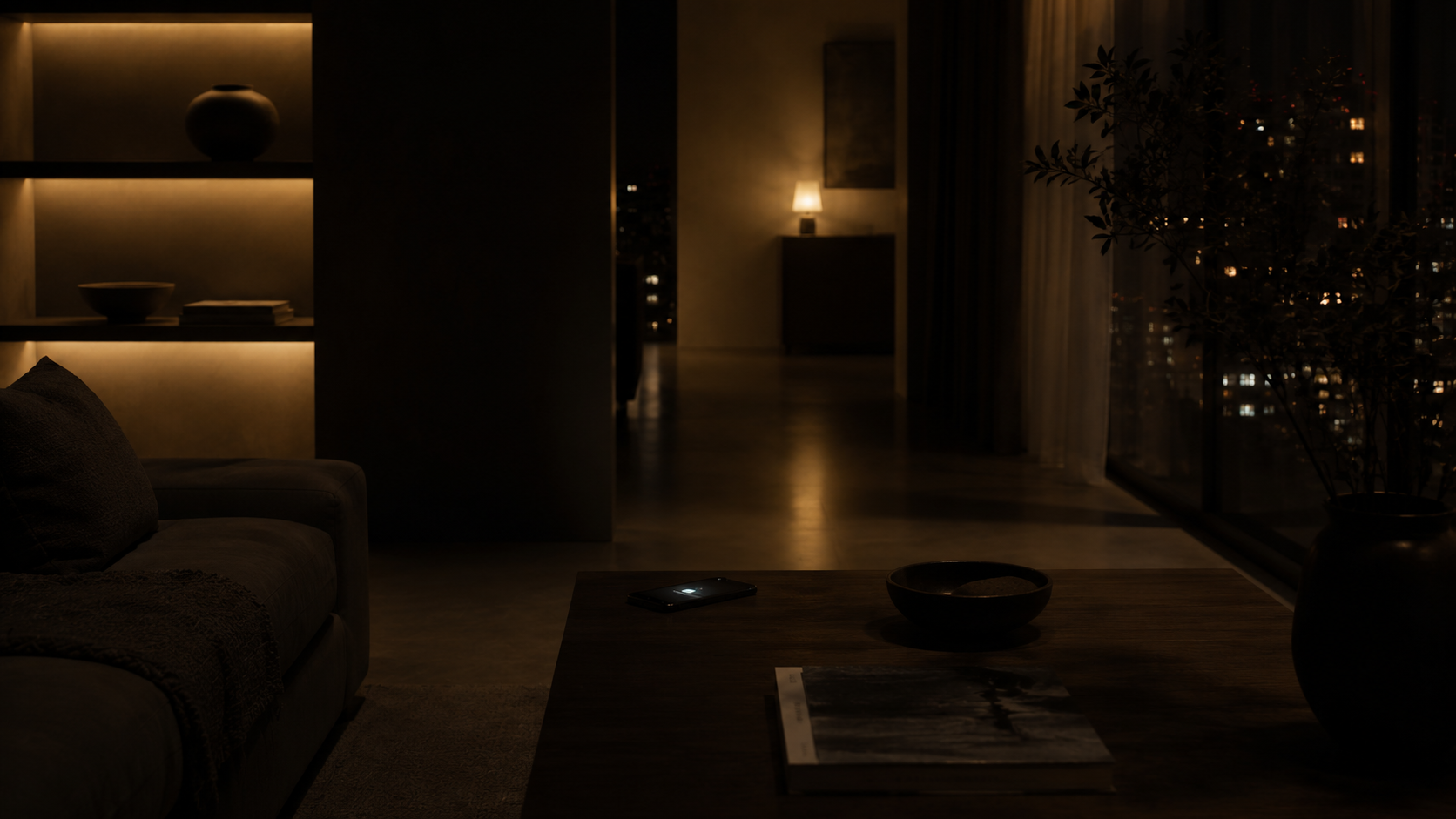
Modern humans spend most of life inside environments designed for efficiency, stimulation, visibility, and continuous engagement.
Notifications compete for attention.
Interfaces maximize interaction.
Urban spaces compress movement and sensory exposure.
Screens remain visually active throughout the day.
Objects accumulate across workspaces, bedrooms, and digital environments simultaneously.
As a result, many individuals now experience a subtle but persistent form of cognitive occupation:
the nervous system rarely receives perceptual spaciousness anymore.
Importantly, this is not simply an aesthetic issue.
The human brain continuously processes environmental information beneath conscious awareness.
Visual density,
clutter,
brightness,
movement,
contrast,
and spatial compression all influence:
- attentional demand
- cognitive load
- emotional regulation
- nervous-system pacing
- stress physiology
- recovery capacity
Environmental psychology increasingly suggests that the spaces humans repeatedly inhabit shape internal states continuously.
The nervous system responds not only to what humans consciously think,
but to what environments repeatedly require from attention.
The Brain Continuously Processes the Environment
Human perception is metabolically expensive.
The brain constantly filters enormous amounts of incoming sensory information involving:
- movement
- brightness
- contrast
- objects
- spatial relationships
- novelty
- facial recognition
- environmental irregularities
- unfinished visual signals
Much of this occurs automatically.
Even environments that appear “normal” may still place substantial processing demands on attentional systems.
This is one reason some spaces feel mentally exhausting despite minimal emotional stress.
The nervous system continuously orients itself within surroundings whether conscious awareness notices it or not.
Environmental perception never fully switches off.
Cognitive Load Is Not Only Mental
Cognitive load refers to the total amount of mental processing required at a given moment.
Traditionally, cognitive load research focused heavily on:
- memory
- learning
- information processing
- task complexity
But environmental psychology increasingly demonstrates that physical surroundings themselves also contribute significantly to cognitive demand.
The brain must continuously process:
- visual complexity
- spatial organization
- informational density
- sensory unpredictability
- environmental movement
This processing consumes attentional resources continuously.
Importantly, the nervous system evolved in environments containing fluctuating periods of lower perceptual demand.
Modern life increasingly reduces those periods.
Visual Density Influences Attentional Fatigue
Research in attentional neuroscience increasingly suggests that environments high in sensory complexity contribute to mental fatigue over time.
Dense visual environments require the brain to continuously:
- filter information
- prioritize stimuli
- suppress distraction
- maintain orienting responses
This becomes particularly significant in modern digital life where attentional systems are repeatedly exposed to:
- notifications
- advertisements
- multiple interfaces
- open tabs
- scrolling feeds
- algorithmic novelty
- constant visual motion
Importantly, attentional fatigue does not always feel dramatic.
Often it appears as:
- difficulty concentrating
- low-level mental exhaustion
- irritability
- shortened attentional endurance
- emotional overstimulation
- inability to feel psychologically spacious
The nervous system rarely receives periods where environmental processing demands soften fully.
Clutter Creates Unfinished Cognitive Loops
Visual clutter influences more than organization.
Research suggests that excessive environmental objects increase attentional competition within the brain.
Each visible object represents potential informational relevance.
The nervous system continuously evaluates:
- importance
- memory association
- task relevance
- unfinished intention
- potential action
Clutter therefore increases what psychologists sometimes describe as attentional residue:
the carryover of unresolved cognitive processing.
Even when individuals consciously ignore clutter,
the brain often continues allocating low-level attentional resources toward environmental monitoring.
This helps explain why cluttered environments frequently correlate with:
- perceived stress
- mental fatigue
- emotional overwhelm
- reduced focus
- decreased task persistence
The issue is not perfectionism.
It is cumulative attentional demand.
Environmental Stress Physiology
Environmental conditions influence physiological stress systems directly.
Research in environmental psychology and neuroarchitecture increasingly demonstrates associations between environmental overstimulation and activation of stress-related physiological processes involving:
- cortisol regulation
- autonomic nervous-system activity
- attentional vigilance
- emotional reactivity
Highly stimulating environments often preserve low-level orienting responses continuously.
The nervous system remains subtly alert.
Importantly, this activation may become chronic without becoming consciously dramatic.
Modern humans increasingly normalize:
- visual overstimulation
- informational density
- environmental fragmentation
- constant movement
- perceptual interruption
As a result, many individuals rarely recognize how strongly environments influence physiological pacing.
The Nervous System Responds to Spatial Rhythm
Humans evolved within environments containing natural perceptual variation.
Open landscapes,
visual depth,
natural movement,
darkness,
shadow,
and periods of reduced sensory complexity all shaped attentional rhythm historically.
Modern environments increasingly compress perceptual experience instead.
Urban density,
screen saturation,
visual advertising,
architectural crowding,
and informational overload preserve attentional activation continuously.
Environmental psychology research increasingly suggests that spatial organization affects:
- emotional regulation
- cognitive restoration
- perceived safety
- attentional recovery
- physiological calmness
Spacious environments often reduce orienting demand because fewer competing stimuli require continuous monitoring.
The nervous system responds strongly to this reduction.
Why Natural Environments Feel Restorative
One of the most significant research territories within environmental psychology involves restorative environment theory.
Researchers such as Stephen Kaplan and Rachel Kaplan developed Attention Restoration Theory (ART), proposing that certain environments help replenish depleted attentional systems.
Natural environments appear particularly important because they contain what researchers describe as “soft fascination”:
stimuli gentle enough to engage attention without exhausting it.
Examples include:
- moving leaves
- water
- clouds
- soft natural light
- environmental depth
- organic textures
These environments differ profoundly from modern high-density informational environments optimized for continuous stimulation.
Natural spaces often reduce:
- attentional competition
- sensory fragmentation
- orienting overload
- cognitive vigilance
The nervous system appears highly responsive to these conditions.
Digital Environments Intensify Perceptual Saturation
The modern cognitive environment is no longer only physical.
Digital architecture now shapes attentional physiology continuously.
Most modern interfaces are intentionally engineered to maximize:
- engagement
- visibility
- interruption
- novelty
- scrolling duration
- attentional retention
This creates environments where attentional systems rarely experience completion.
Infinite feeds remove stopping cues.
Notifications preserve anticipatory vigilance.
Visual motion continuously captures orienting responses.
Importantly, the nervous system evolved within environments containing natural perceptual endings.
Modern digital environments increasingly remove those endings entirely.
The result may be continuous low-level attentional occupation.
Spaciousness Influences Emotional Regulation
Environmental spaciousness affects more than visual preference.
It influences how the nervous system distributes attention internally.
Environments containing:
- reduced visual density
- slower pacing
- softer lighting
- organized spatial rhythm
- lower informational competition
often support:
- emotional regulation
- attentional settling
- reduced vigilance
- reflective cognition
- psychological decompression
Importantly, spaciousness does not necessarily mean minimalism.
The issue is not emptiness.
The issue is whether environments continuously demand orienting and filtering.
The nervous system appears highly sensitive to this distinction.
Modern Life Rarely Allows Perceptual Recovery
Historically, human environments naturally fluctuated between:
stimulation,
movement,
quietness,
darkness,
social intensity,
and sensory reduction.
Modern environments increasingly preserve:
continuous visual engagement instead.
The eyes remain active.
Screens remain illuminated.
Interfaces remain open.
Objects remain visible.
Notifications remain possible.
The nervous system rarely encounters environments communicating:
nothing further requires processing right now.
This may help explain why many individuals feel:
mentally occupied even during rest,
physically inactive yet cognitively overstimulated,
and emotionally fatigued despite limited physical exertion.
The body may not simply require more rest.
It may increasingly require environments containing reduced perceptual demand.
Environmental Rhythm May Be Essential for Restoration
Modern culture often approaches wellbeing psychologically:
through mindset,
motivation,
optimization,
or emotional management.
But environments themselves participate in nervous-system regulation continuously.
Light shapes pacing.
Sound shapes vigilance.
Space shapes attentional load.
Spatial rhythm shapes emotional spaciousness.
Humans evolved within environments containing variation between:
activation,
openness,
stillness,
and restoration.
Modern life increasingly compresses these distinctions into continuous stimulation density.
The nervous system may not require perfectly minimal environments.
But it may still depend on periods where perception itself can soften.
Where attention no longer needs to continuously scan,
filter,
prioritize,
and orient toward incoming demand.
In a world built around continuous cognitive occupation,
spaciousness may increasingly become a physiological necessity rather than a luxury.